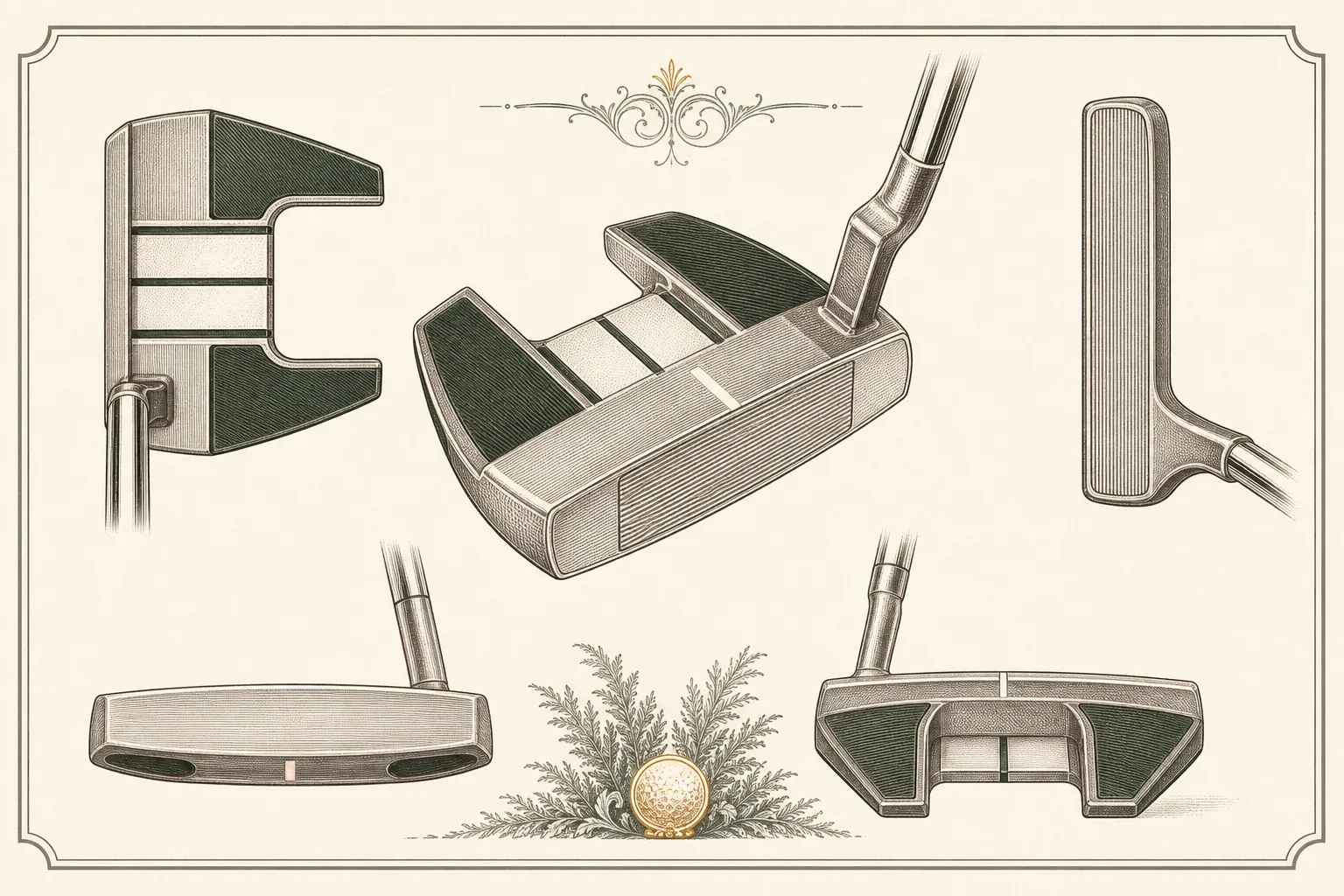
“The award winner that put Evnroll on the map, taking MyGolfSpy's Most Wanted Blade. A wider heel-and-toe blade whose Sweet Face grooves keep distance dead-even on mishits; a great pick for a mild-arc stroke.”
The ER2 is the mid-blade that put Evnroll on the map. When Guerin Rife — who invented putter face grooves at Rife Putters (2000-2009) — launched Evnroll in 2016, the ER2 was the widest-bodied of the three original blades, a compact Anser-style head milled from solid 303 stainless steel and hand-finished in Carlsbad, California. Its whole reason for being is SweetFace: a variable-width groove pattern (tight in the center, wider toward heel and toe) that 'gears' off-center strikes back toward target and equalizes ball speed, so a toe-strike rolls nearly as far as a flush one. In 2017 the ER2 won MyGolfSpy's Most Wanted blade outright, and Evnroll became the first brand ever to take both blade and mallet titles the same year. It is the model the whole company is built around.
Repeated, independent, decade-spanning test dominance rather than nostalgia: the ER2 won MyGolfSpy's 2017 'Most Wanted' blade (SG18 rating 0.96, beating the field by 0.35 strokes), Evnroll swept both blade and mallet Most Wanted titles in 2017 and again in 2018 — a first in the award's history — and the Neo Classic ER2 was named MyGolfSpy's Best Blade of 2024. A small-batch, made-in-USA boutique putter that keeps beating $600 mass-market rivals in blind robot-and-golfer testing has earned a genuine following among gear enthusiasts, not a manufactured one.
Best for the golfer who wants a traditional blade look and a stroke with a touch of arc (the single-bend shaft creates slight toe hang), but who wants insurance on distance control from 5-15 feet. In MyGolfSpy testing the Neo Classic ER2 posted the best 5-foot make score and shone at 10 feet. Not the pick for a golfer who needs maximum directional MOI to fight a pull or the yips — an ER10/ER11 mallet suits them better — nor for a bargain hunter, given the boutique price.
Launched 2016 into a putter market dominated by Scotty Cameron, Odyssey and TaylorMade, where 'forgiveness' meant adding MOI via bigger mallets. Evnroll's pitch was orthogonal: fix the FACE, not just the head. The ER2 has since been reissued across Evnroll's own sub-lines — the milled Tour Spec ER2, the insert-faced Neo Classic ER2, and the 2023 Origin ER2 with SweetFace 2.0 — so the nameplate spans the brand's entire history. Its closest conceptual rival is a Scotty Cameron Newport 2 or an Odyssey White Hot; the ER2's differentiator remains the variable-groove face.
High for a blade putter specifically because forgiveness here is two separate things and Evnroll addresses both. Directionally it is a moderate-MOI heel-toe blade — the ER2 had the widest head in its Most Wanted blade group, so it is more stable than a slim classic Anser but well short of a mallet. Where it genuinely excels is DISTANCE forgiveness: SweetFace's variable grooves keep ball speed near-constant across the face, so mishits finish close to pin-high even when the direction wanders. That distance-consistency is why a 7 (not the ~5-6 a plain blade would earn) is justified — but it is not a max-MOI mallet and should not be scored like one.
Calibrated across the whole catalog — a tour blade scores low here on purpose; it means control, not ease.
Original milled ER2 heads realistically trade for roughly $120-200 private-party in 2026 (SidelineSwap/eBay), with the newer V-Series ER2v around $150 used and Neo Classic/Origin versions higher (~$180-280). Watch the reconditioned-retail gap: 2nd Swing lists new Origin ER2 at $399 and graded/warrantied used models well above private-party street value, and clearance sellers like Golf Partner USA discount short-length steel ER2s to ~$120-190 — those store prices sit above what a private buyer typically pays for a used one. Boutique scarcity and made-in-USA milling hold value better than a mass-market blade, but this is a modern used putter, not an appreciating collectible.
Reading is one thing — hitting is another. Book a bay and see the numbers for yourself before you buy anywhere.