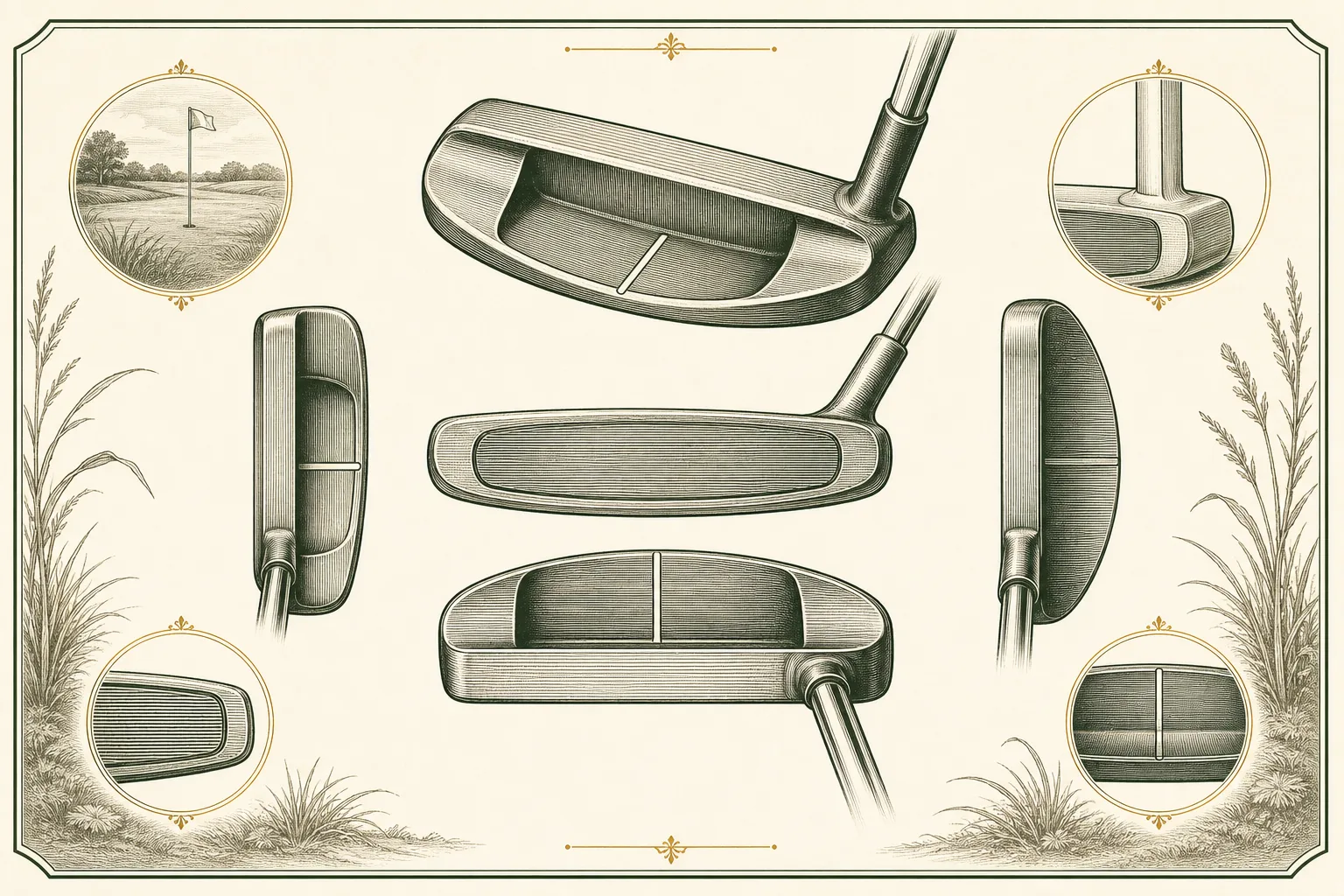
“The B-Series flanged blades sit on the same back-weighted, counterbalanced Heavy Putter platform for a steadier pendulum stroke. Mild toe hang suits a slight-arc stroke. Traditional shaping with a modern weight scheme.”
The Heavy Putter was mechanical engineer Stephen Boccieri's rebellion against 340-gram convention: launched at the 2005 PGA Merchandise Show out of Ridgefield, Connecticut, it paired a head of roughly 475 grams with a 250-gram counterweight under the grip, pushing the balance point about 75% up the shaft so the shoulders — not the hands — drive the stroke. The B-Series was the blade expression of that idea: CNC-milled stainless flanged blades (B1, B1-M matte, B3, B3-M), largely center-shafted and face-balanced, weighing near 900 grams all-in against a conventional putter's ~500. The company renamed itself Boccieri Golf in February 2006 as the putter took off, and the concept earned Golf Digest Hot List recognition three times in four years. Reception was genuinely polarized: TheSandTrap's B3 review praised short-putt stability but found mid-range feel 'surprisingly flimsy' and lag putts chronically short, concluding it could not be recommended — while owner reviews on GolfReview ran 4.7/5 across a dozen B3 write-ups, and GolfWRX threads still turn up self-described Heavy Putter loyalists years after production ended.
Three Golf Digest Hot List honors in four years, a real tour validation — Troy Matteson jumped from 110th to 8th in Nationwide Tour putting stats after switching and won the 2006 Frys.com Open — and long-running polarized GolfWRX threads mark a genuine dent in putter design; resale near $50 shows no collector demand followed it.
For a golfer with handsy, jabby tendencies or short-putt yips who wants the club's mass to enforce a slow, shoulders-led pendulum — it is close to a training aid you can legally game. Players with delicate touch-based lag styles, fast greens, or an attachment to traditional blade feel tended to hate it; the weight is a commitment, not a tweak.
It arrived nearly a decade before counterbalancing went mainstream — Odyssey's Tank line and the counterbalance wave surrounding the 2013–2016 anchoring ban followed the same physics Boccieri was selling in 2005, just in milder doses. Against mid-2000s rivals like the Scotty Cameron Newport or Odyssey White Hot blades it was a radical outlier, roughly 400 grams heavier all-in.
Off-center forgiveness is the entire engineering pitch, and it largely delivers: a ~475g head resists twisting on heel and toe strikes far better than a 340g blade, so mishits hold their line unusually well for a blade shape. The catch is pace, not line — the mass blunts touch on long lag putts (period reviewers reported 40-footers finishing five feet short), so it forgives strike location while demanding a rebuilt distance feel.
Calibrated across the whole catalog — a tour blade scores low here on purpose; it means control, not ease.
Cheap to try and worthless to hoard: 2026 resale guides put B-Series blades like the B1-M at roughly $40–55, with private-party eBay and SidelineSwap examples in the same range and graded-retailer trade-in credit running lower still. Buy one to test the heavy-pendulum theory, not as an investment.
Reading is one thing — hitting is another. Book a bay and see the numbers for yourself before you buy anywhere.
“The B-Series flanged blades sit on the same back-weighted, counterbalanced Heavy Putter platform for a steadier pendulum stroke. Mild toe hang suits a slight-arc stroke. Traditional shaping with a modern weight scheme.”
The Heavy Putter was mechanical engineer Stephen Boccieri's rebellion against 340-gram convention: launched at the 2005 PGA Merchandise Show out of Ridgefield, Connecticut, it paired a head of roughly 475 grams with a 250-gram counterweight under the grip, pushing the balance point about 75% up the shaft so the shoulders — not the hands — drive the stroke. The B-Series was the blade expression of that idea: CNC-milled stainless flanged blades (B1, B1-M matte, B3, B3-M), largely center-shafted and face-balanced, weighing near 900 grams all-in against a conventional putter's ~500. The company renamed itself Boccieri Golf in February 2006 as the putter took off, and the concept earned Golf Digest Hot List recognition three times in four years. Reception was genuinely polarized: TheSandTrap's B3 review praised short-putt stability but found mid-range feel 'surprisingly flimsy' and lag putts chronically short, concluding it could not be recommended — while owner reviews on GolfReview ran 4.7/5 across a dozen B3 write-ups, and GolfWRX threads still turn up self-described Heavy Putter loyalists years after production ended.
Three Golf Digest Hot List honors in four years, a real tour validation — Troy Matteson jumped from 110th to 8th in Nationwide Tour putting stats after switching and won the 2006 Frys.com Open — and long-running polarized GolfWRX threads mark a genuine dent in putter design; resale near $50 shows no collector demand followed it.
For a golfer with handsy, jabby tendencies or short-putt yips who wants the club's mass to enforce a slow, shoulders-led pendulum — it is close to a training aid you can legally game. Players with delicate touch-based lag styles, fast greens, or an attachment to traditional blade feel tended to hate it; the weight is a commitment, not a tweak.
It arrived nearly a decade before counterbalancing went mainstream — Odyssey's Tank line and the counterbalance wave surrounding the 2013–2016 anchoring ban followed the same physics Boccieri was selling in 2005, just in milder doses. Against mid-2000s rivals like the Scotty Cameron Newport or Odyssey White Hot blades it was a radical outlier, roughly 400 grams heavier all-in.
Off-center forgiveness is the entire engineering pitch, and it largely delivers: a ~475g head resists twisting on heel and toe strikes far better than a 340g blade, so mishits hold their line unusually well for a blade shape. The catch is pace, not line — the mass blunts touch on long lag putts (period reviewers reported 40-footers finishing five feet short), so it forgives strike location while demanding a rebuilt distance feel.
Calibrated across the whole catalog — a tour blade scores low here on purpose; it means control, not ease.
Cheap to try and worthless to hoard: 2026 resale guides put B-Series blades like the B1-M at roughly $40–55, with private-party eBay and SidelineSwap examples in the same range and graded-retailer trade-in credit running lower still. Buy one to test the heavy-pendulum theory, not as an investment.
Reading is one thing — hitting is another. Book a bay and see the numbers for yourself before you buy anywhere.