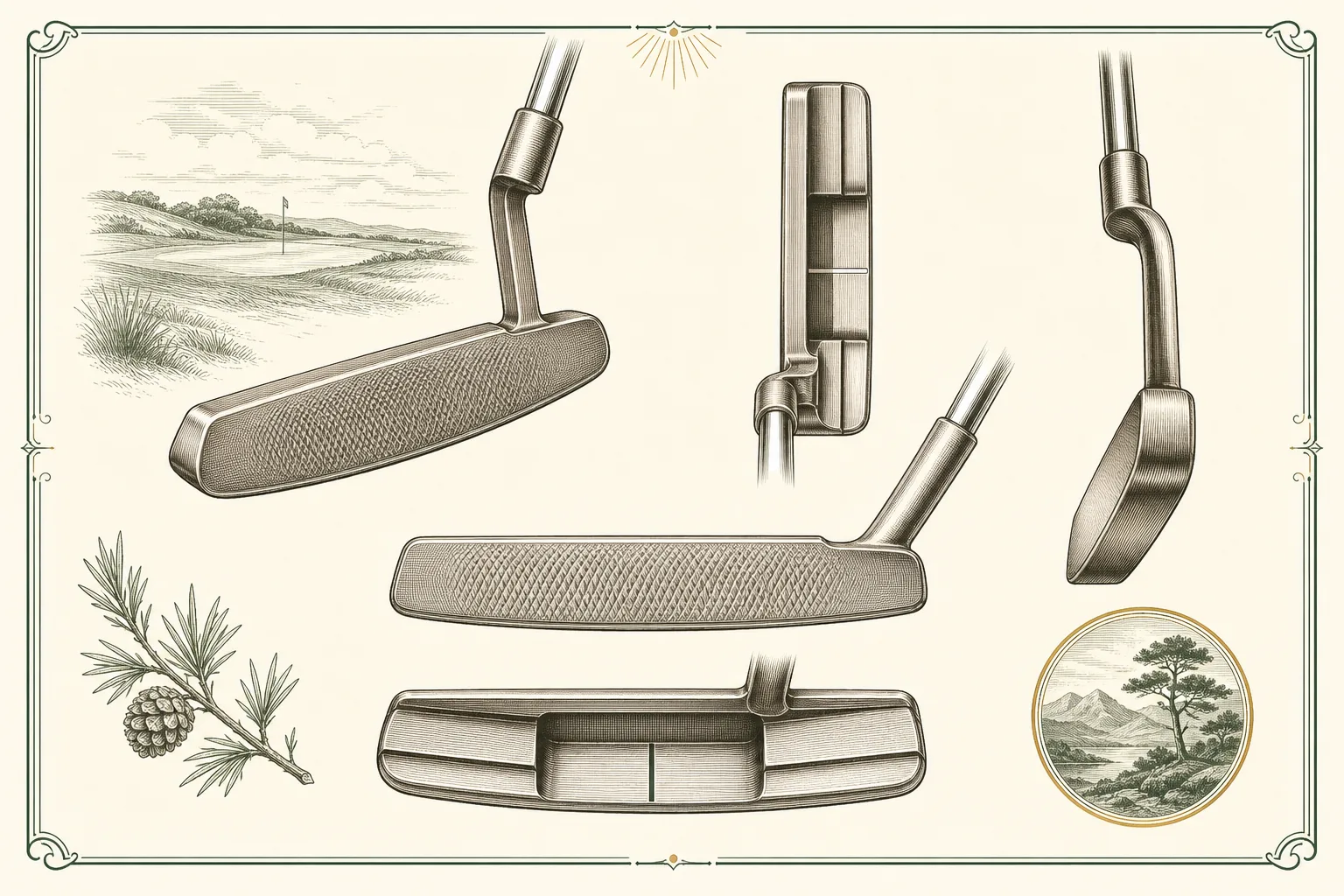
“Haywood milled blade putter. Identity club.”
Sold by Haywood Golf as the Signature Putter, this is the Vancouver direct-to-consumer brand's take on the Anser 2: CNC milled from a solid block, slightly wider than a standard Anser thanks to longer bumpers, with a plumber's neck, roughly 4 o'clock toe hang, and interchangeable heel-toe sole weights (10-gram stock, with 5- and 15-gram options sold as a kit). Its signature detail is the dual sight line — one on the topline, one on the flange — so the player can cross-check squareness before every putt. Plugged In Golf reviewed it in September 2020 and called it 'a premium putter without the premium name up-charge' at $200, and GOLF.com's ClubTest 2022 panel followed, with a tester describing the feel as 'like a knife, in a good way' — firm-but-soft with honest feedback that makes poor strokes obvious. Like everything Haywood sells, it ships custom-built from Canada in about three weeks rather than off a rack.
Two genuinely independent reviews — Plugged In Golf's 2020 write-up and GOLF.com's ClubTest 2022 panel — both landed positive on feel and value, which is more third-party validation than most direct-to-consumer putters ever earn; there is, however, no collector following or forum reverence, and awareness remains tied to the brand's iron-led reputation.
For the accomplished or improving putter who wants a traditional plumber's-neck blade with an arc-friendly toe hang, likes tinkering with head weight via the screw kit, and would rather pay direct-to-consumer money than a boutique-brand premium for milled construction. A player who struggles with strike location or needs maximum alignment help should look at a mallet instead.
It launched into the early-2020s wave of direct-to-consumer challengers undercutting Scotty Cameron and Bettinardi milled blades that retail at roughly double the price, and it predates Haywood's own mid-mallet by more than two years — the brand's first flat stick, arriving while its forged irons were doing the reputational heavy lifting.
A blade is a blade: the slightly-wider-than-Anser body and adjustable heel-toe weighting add a touch of stability over a classic narrow blade, but GOLF.com's tester noted poor strokes show up plainly, and Plugged In Golf found mishits transmit less feedback through the hands than expected — this is a feel-first head for players who find the ball's center, not a high-stability mallet substitute.
Calibrated across the whole catalog — a tour blade scores low here on purpose; it means control, not ease.
Thin but findable in 2026: 2nd Swing carried used examples at roughly $166–170 in average-to-mint condition, SidelineSwap listings run up to $200, and new-direct pricing starts around $175–200 — so the used discount is modest because the new price never carried retail markup to begin with.
Reading is one thing — hitting is another. Book a bay and see the numbers for yourself before you buy anywhere.
“Haywood milled blade putter. Identity club.”
Sold by Haywood Golf as the Signature Putter, this is the Vancouver direct-to-consumer brand's take on the Anser 2: CNC milled from a solid block, slightly wider than a standard Anser thanks to longer bumpers, with a plumber's neck, roughly 4 o'clock toe hang, and interchangeable heel-toe sole weights (10-gram stock, with 5- and 15-gram options sold as a kit). Its signature detail is the dual sight line — one on the topline, one on the flange — so the player can cross-check squareness before every putt. Plugged In Golf reviewed it in September 2020 and called it 'a premium putter without the premium name up-charge' at $200, and GOLF.com's ClubTest 2022 panel followed, with a tester describing the feel as 'like a knife, in a good way' — firm-but-soft with honest feedback that makes poor strokes obvious. Like everything Haywood sells, it ships custom-built from Canada in about three weeks rather than off a rack.
Two genuinely independent reviews — Plugged In Golf's 2020 write-up and GOLF.com's ClubTest 2022 panel — both landed positive on feel and value, which is more third-party validation than most direct-to-consumer putters ever earn; there is, however, no collector following or forum reverence, and awareness remains tied to the brand's iron-led reputation.
For the accomplished or improving putter who wants a traditional plumber's-neck blade with an arc-friendly toe hang, likes tinkering with head weight via the screw kit, and would rather pay direct-to-consumer money than a boutique-brand premium for milled construction. A player who struggles with strike location or needs maximum alignment help should look at a mallet instead.
It launched into the early-2020s wave of direct-to-consumer challengers undercutting Scotty Cameron and Bettinardi milled blades that retail at roughly double the price, and it predates Haywood's own mid-mallet by more than two years — the brand's first flat stick, arriving while its forged irons were doing the reputational heavy lifting.
A blade is a blade: the slightly-wider-than-Anser body and adjustable heel-toe weighting add a touch of stability over a classic narrow blade, but GOLF.com's tester noted poor strokes show up plainly, and Plugged In Golf found mishits transmit less feedback through the hands than expected — this is a feel-first head for players who find the ball's center, not a high-stability mallet substitute.
Calibrated across the whole catalog — a tour blade scores low here on purpose; it means control, not ease.
Thin but findable in 2026: 2nd Swing carried used examples at roughly $166–170 in average-to-mint condition, SidelineSwap listings run up to $200, and new-direct pricing starts around $175–200 — so the used discount is modest because the new price never carried retail markup to begin with.
Reading is one thing — hitting is another. Book a bay and see the numbers for yourself before you buy anywhere.