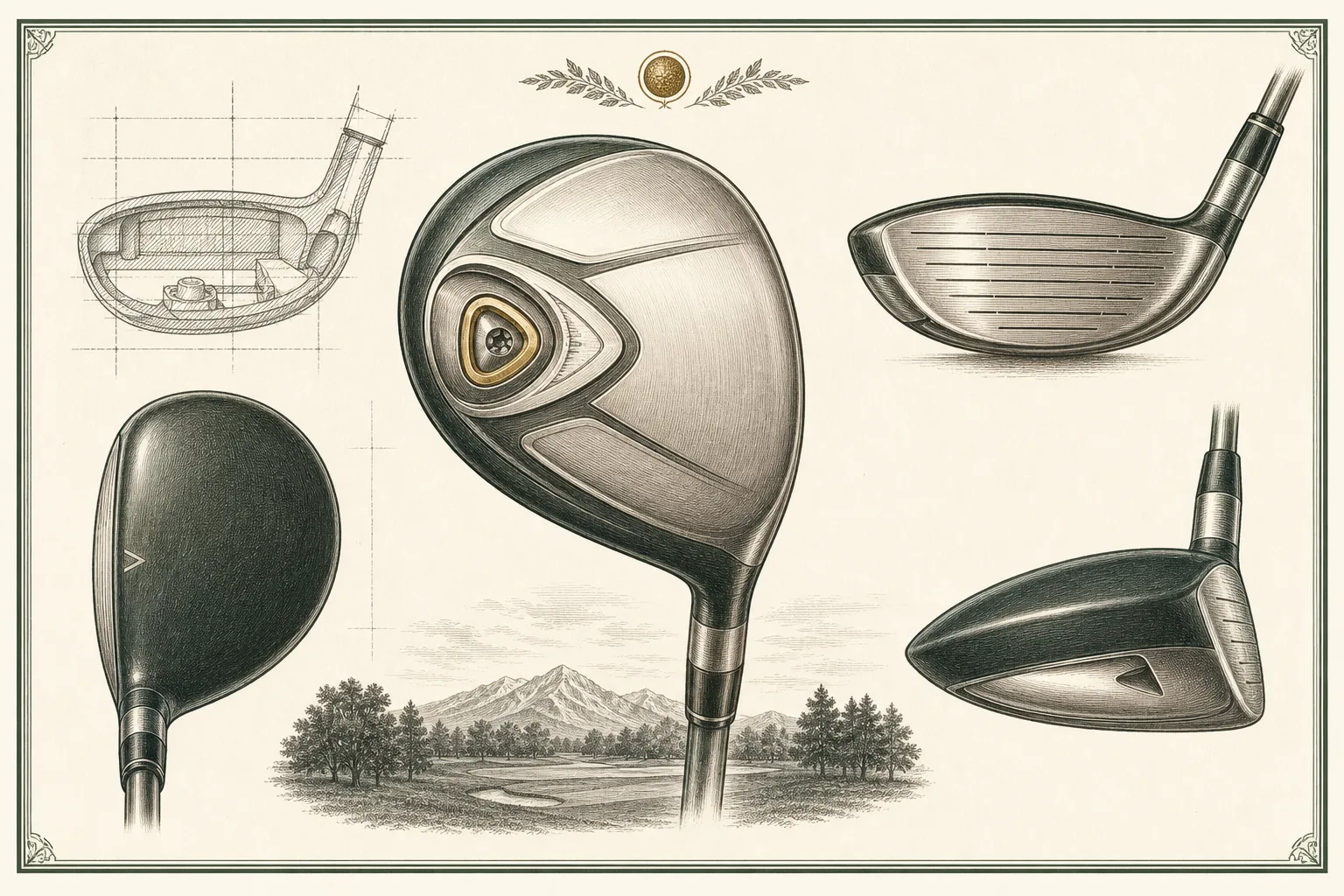
“An early-2000s steel fairway with a compact head. Fine off a tee for a decent swing, but modern fairways are far easier off the deck. A tool that's aged out.”
The 904F (2004) succeeded the 980F and, per contemporary testing, gained an average of 16 yards of carry — a large enough jump that period reviewers called it the best fairway wood Titleist had made, and some ranked it among the best available from any manufacturer at the time. It uses a two-piece 'face pull' construction: a thinner, uniform 275 Carpenter Steel face insert welded into a 355 Carpenter Steel body for a firm, lively feel and higher ball speed. Enough players trusted its control that some reportedly hit the graphite-shafted 15° 3-wood off the tee in place of a driver, giving up little carry distance for a meaningful gain in accuracy — the signature trait of a well-liked players' fairway wood.
Enthusiast forums still praise it well after its era ended — a GolfWRX thread titled 'Man, Titleist 904f Fairway Woods are REALLY Good' and a 4.6/5 rating across 42 golfreview.com reviews both point to a quiet, lasting reputation among players who owned one, without the club ever crossing into mainstream cult-classic recognition.
Skilled ball-strikers and single-digit handicappers who valued control off the tee and deck enough that some used the 15° 3-wood in place of a driver. Not aimed at high handicappers seeking maximum forgiveness — today's game-improvement fairway woods would serve that player far better.
Released in 2004 as the successor to the 980F, competing with Callaway's Great Big Bertha II fairway woods and TaylorMade's R7 fairway line; it was itself succeeded by the 906F(4) around 2006. The modern equivalent in Titleist's current line is the TSi/TSR fairway wood family, which trades some of the 904F's compact, players'-club feel for significantly more forgiveness.
Built and marketed as a players' fairway wood focused on feel, control and distance gain versus its 980F predecessor rather than on forgiveness features — no offset or wide-sole game-improvement emphasis appears in period coverage. Scored as moderate for its era; modern game-improvement fairway woods are considerably more forgiving through perimeter weighting and larger, more tolerant faces.
Calibrated across the whole catalog — a tour blade scores low here on purpose; it means control, not ease.
As a 20+ year old players' fairway wood with no collector premium but a persistent enthusiast reputation, realistic 2026 private-party prices run roughly $50-100 depending on shaft and condition.
Reading is one thing — hitting is another. Book a bay and see the numbers for yourself before you buy anywhere.