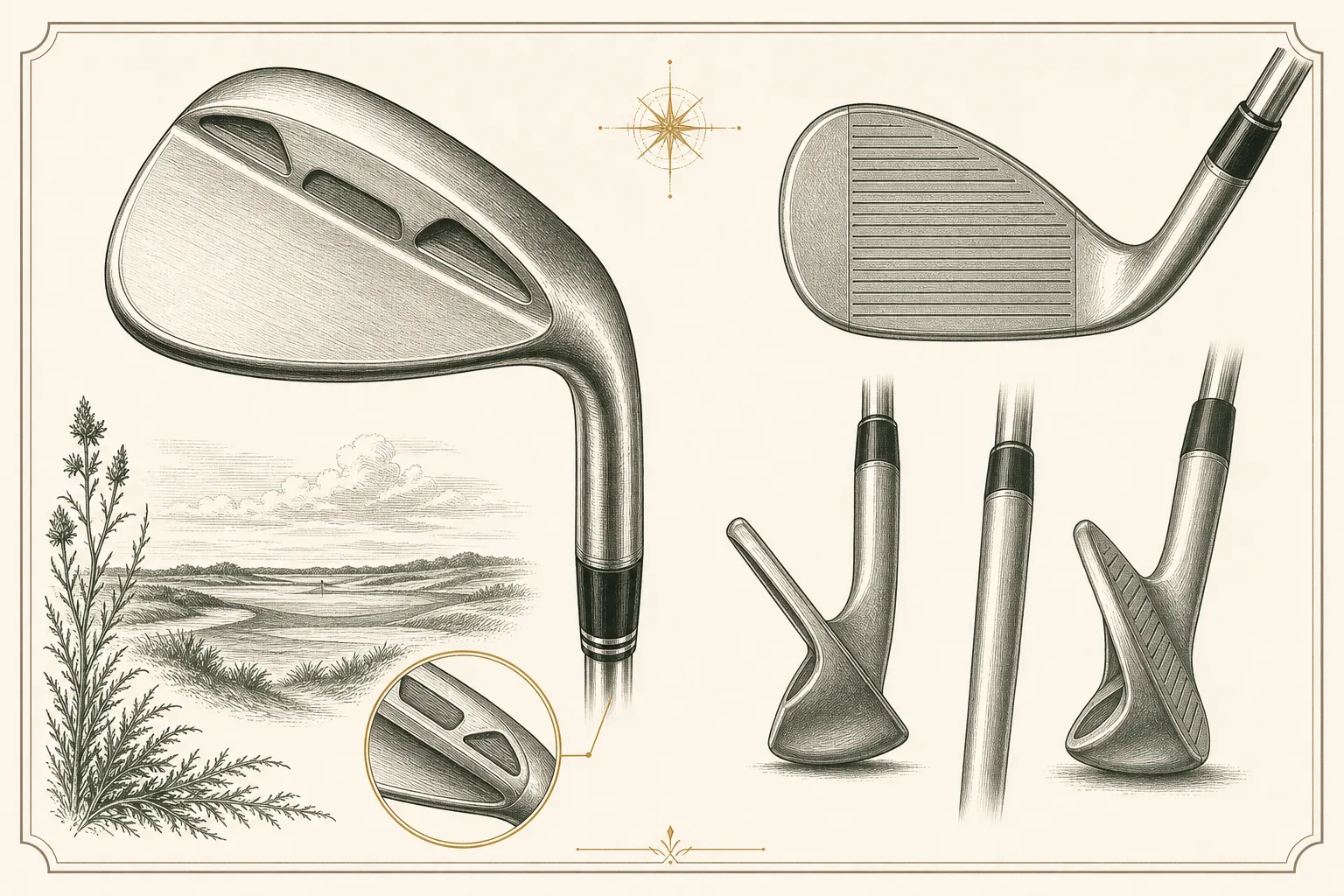
“The award-magnet that put Fourteen wedges on the map. Reverse-muscleback weighting gives a heavier, more solid strike than a plain blade, and the enlarged trapezoidal grooves grab on partials. A players' tour-milled pick for a feel player who still wants a touch of stability.”
The RM-11 is the wedge that put Fourteen on the radar outside Japan. It carried the brand's 'reverse muscle' design — extra mass built up on the upper blade rather than a conventional low-heavy cavity — into a nickel-chrome-molybdenum forging with enlarged, 15%-bigger trapezoidal grooves than Fourteen's prior M-28 J.spec-IV. Golfing Magazine's 2012 reader-tested Player's Awards gave it all six categories it was eligible for, including the year's only 'Best Feel' award, in a field that included a Ping Anser and a TaylorMade ATV. It is the model most credited with building Fourteen's reputation as a serious wedge maker rather than a curiosity import, and its reverse-muscleback profile set the template every RM generation since has refined rather than replaced.
It swept an independent, reader-tested award program (Golfing Magazine, 2012) against established US brands and is still the model GolfWRX 'Japanese and Non-US' forum threads point to when explaining why Fourteen wedges are worth seeking out — but it never crossed into mainstream US awareness the way a Vokey or a Cleveland does. That combination of genuine, tested excellence plus near-zero mainstream brand recognition is the definition of a sleeper rather than a cult classic with an active collector market.
Better ball-strikers and dedicated short-game players who want soft forged feel with a bit more stability than a pure blade wedge — the profile the awards were built around. A high-handicap player who mishits wedges frequently and wants maximum grace, or anyone unwilling to hand-fit lofts/bounce, is better served by a modern game-improvement wedge with a wider sole.
Launched into a 2011-2012 US wedge market dominated by Titleist Vokey SM4/SM5, Cleveland CG15/RTX and Callaway MD1 — the RM-11's award sweep against a Ping Anser and TaylorMade ATV shows it was competitive with that field on testers' terms, even though it never captured comparable market share. It was succeeded by the RM-12 (2013), which kept the reverse-muscle concept but added the H-Sole/C-grind.
The reverse-muscleback distributes weight to stabilize the face through impact, which is precisely why it won 'Best Forgiveness' in its own 2012 test field — genuinely more tolerant of mis-hits than a flat, blade-backed tour wedge. It is still a compact, forged players' wedge, not a cavity or perimeter-weighted design, so this is forgiveness relative to other tour wedges, not relative to a game-improvement iron.
Calibrated across the whole catalog — a tour blade scores low here on purpose; it means control, not ease.
A niche, decade-plus-old Japanese import with thin US secondary-market liquidity: individual clean RM-11 wedges typically sell for roughly $40-80 on eBay/2nd Swing depending on condition and grind, with worn grooves or rust knocking value toward the bottom of that band. It holds no collector premium — value is purely functional, and buyers are almost entirely JDM-wedge enthusiasts rather than casual shoppers.
Reading is one thing — hitting is another. Book a bay and see the numbers for yourself before you buy anywhere.
“The award-magnet that put Fourteen wedges on the map. Reverse-muscleback weighting gives a heavier, more solid strike than a plain blade, and the enlarged trapezoidal grooves grab on partials. A players' tour-milled pick for a feel player who still wants a touch of stability.”
The RM-11 is the wedge that put Fourteen on the radar outside Japan. It carried the brand's 'reverse muscle' design — extra mass built up on the upper blade rather than a conventional low-heavy cavity — into a nickel-chrome-molybdenum forging with enlarged, 15%-bigger trapezoidal grooves than Fourteen's prior M-28 J.spec-IV. Golfing Magazine's 2012 reader-tested Player's Awards gave it all six categories it was eligible for, including the year's only 'Best Feel' award, in a field that included a Ping Anser and a TaylorMade ATV. It is the model most credited with building Fourteen's reputation as a serious wedge maker rather than a curiosity import, and its reverse-muscleback profile set the template every RM generation since has refined rather than replaced.
It swept an independent, reader-tested award program (Golfing Magazine, 2012) against established US brands and is still the model GolfWRX 'Japanese and Non-US' forum threads point to when explaining why Fourteen wedges are worth seeking out — but it never crossed into mainstream US awareness the way a Vokey or a Cleveland does. That combination of genuine, tested excellence plus near-zero mainstream brand recognition is the definition of a sleeper rather than a cult classic with an active collector market.
Better ball-strikers and dedicated short-game players who want soft forged feel with a bit more stability than a pure blade wedge — the profile the awards were built around. A high-handicap player who mishits wedges frequently and wants maximum grace, or anyone unwilling to hand-fit lofts/bounce, is better served by a modern game-improvement wedge with a wider sole.
Launched into a 2011-2012 US wedge market dominated by Titleist Vokey SM4/SM5, Cleveland CG15/RTX and Callaway MD1 — the RM-11's award sweep against a Ping Anser and TaylorMade ATV shows it was competitive with that field on testers' terms, even though it never captured comparable market share. It was succeeded by the RM-12 (2013), which kept the reverse-muscle concept but added the H-Sole/C-grind.
The reverse-muscleback distributes weight to stabilize the face through impact, which is precisely why it won 'Best Forgiveness' in its own 2012 test field — genuinely more tolerant of mis-hits than a flat, blade-backed tour wedge. It is still a compact, forged players' wedge, not a cavity or perimeter-weighted design, so this is forgiveness relative to other tour wedges, not relative to a game-improvement iron.
Calibrated across the whole catalog — a tour blade scores low here on purpose; it means control, not ease.
A niche, decade-plus-old Japanese import with thin US secondary-market liquidity: individual clean RM-11 wedges typically sell for roughly $40-80 on eBay/2nd Swing depending on condition and grind, with worn grooves or rust knocking value toward the bottom of that band. It holds no collector premium — value is purely functional, and buyers are almost entirely JDM-wedge enthusiasts rather than casual shoppers.
Reading is one thing — hitting is another. Book a bay and see the numbers for yourself before you buy anywhere.