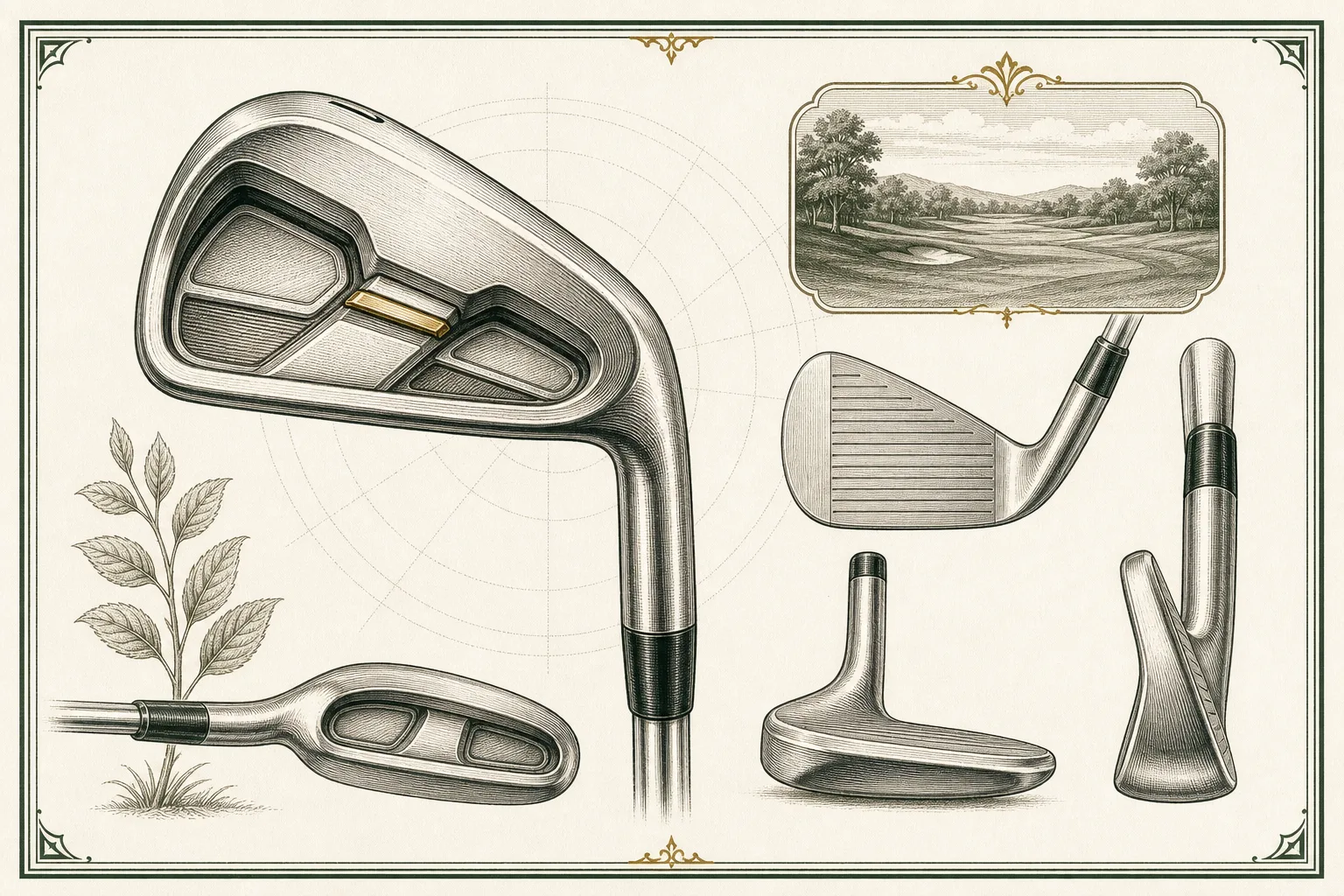
“A rung-2 forged set with a longer heel-to-toe head and twin pockets for mid-to-high launch and added stability. More forgiving sibling to the J40 CB. Great value used for a mid-handicap who still wants soft forged feel.”
The J40 Dual Pocket Cavity lengthened the head heel-to-toe versus its J38 predecessor and kept the twin pocket cavities that route discretionary weight to the perimeter for stability, while leaving real mass directly behind the face for the soft, buttery forged feel Bridgestone was known for. Fred Couples carried this exact head — 3-PW with Aerotech SteelFiber i95S shafts — in his own tour bag as of 2014, and reviewer Jason Kunze at The Hackers Paradise reported swapping into a demo set in the parking lot and immediately shooting a personal best, then beating that score again in follow-up testing. At $699 street ($799 MSRP), it undercut rival forged cavity-backs from Titleist and Mizuno while matching their construction quality.
The strongest sleeper case in the whole J-series: a real, documented multi-year PGA Tour Champions bag credential (Fred Couples) and an enthusiastic multi-outlet review record (The Hackers Paradise, Golf Tips, Golf Guide, GolfWRX forum threads), plus a reviewer's personal-best-round anecdote — genuine substance, not marketing puffery. What keeps it from 'cult classic' status is the complete absence of a secondary-market chase: no price premium, no scarcity, no dedicated forum thread asking why it's so good. It's excellent and essentially unknown outside a small circle of Bridgestone loyalists.
Mid-to-low handicaps wanting a forgiving forged iron with real workability — exactly the profile of a Champions Tour pro like Couples as well as a low-single-digit amateur. A true beginner will still find more forgiveness in a modern max-GI iron, but for anyone who can find the middle of the face reasonably often, this is a big step up from a blade or players cavity.
Released for 2011 as the direct successor to the well-regarded J38 Dual Pocket Cavity, going up against Titleist's 712 CB/AP2, Mizuno's MP-60/62, and Ping's i15/i20 in the better-player forgiveness category; Bridgestone continued the concept into the J15 line that Couples eventually moved to after roughly a decade in this shape.
The longer heel-to-toe profile and dual pockets specifically add stability and forgiveness versus the J38 DPC it replaced, per Bridgestone's own marketing and independent reviews — the most forgiving standard cavity design in the Bridgestone J-series covered here, though still a midsize forged head rather than a true wide-sole game-improvement iron.
Calibrated across the whole catalog — a tour blade scores low here on purpose; it means control, not ease.
Cheap relative to its on-course pedigree: clean complete sets typically sell for roughly $150-250 in 2026, similar to the rest of the J-series and far below what a Tour-validated Titleist or Ping iron of the same vintage would command — Bridgestone's small US iron market share keeps demand, and resale price, modest despite genuine quality.
Reading is one thing — hitting is another. Book a bay and see the numbers for yourself before you buy anywhere.
“A rung-2 forged set with a longer heel-to-toe head and twin pockets for mid-to-high launch and added stability. More forgiving sibling to the J40 CB. Great value used for a mid-handicap who still wants soft forged feel.”
The J40 Dual Pocket Cavity lengthened the head heel-to-toe versus its J38 predecessor and kept the twin pocket cavities that route discretionary weight to the perimeter for stability, while leaving real mass directly behind the face for the soft, buttery forged feel Bridgestone was known for. Fred Couples carried this exact head — 3-PW with Aerotech SteelFiber i95S shafts — in his own tour bag as of 2014, and reviewer Jason Kunze at The Hackers Paradise reported swapping into a demo set in the parking lot and immediately shooting a personal best, then beating that score again in follow-up testing. At $699 street ($799 MSRP), it undercut rival forged cavity-backs from Titleist and Mizuno while matching their construction quality.
The strongest sleeper case in the whole J-series: a real, documented multi-year PGA Tour Champions bag credential (Fred Couples) and an enthusiastic multi-outlet review record (The Hackers Paradise, Golf Tips, Golf Guide, GolfWRX forum threads), plus a reviewer's personal-best-round anecdote — genuine substance, not marketing puffery. What keeps it from 'cult classic' status is the complete absence of a secondary-market chase: no price premium, no scarcity, no dedicated forum thread asking why it's so good. It's excellent and essentially unknown outside a small circle of Bridgestone loyalists.
Mid-to-low handicaps wanting a forgiving forged iron with real workability — exactly the profile of a Champions Tour pro like Couples as well as a low-single-digit amateur. A true beginner will still find more forgiveness in a modern max-GI iron, but for anyone who can find the middle of the face reasonably often, this is a big step up from a blade or players cavity.
Released for 2011 as the direct successor to the well-regarded J38 Dual Pocket Cavity, going up against Titleist's 712 CB/AP2, Mizuno's MP-60/62, and Ping's i15/i20 in the better-player forgiveness category; Bridgestone continued the concept into the J15 line that Couples eventually moved to after roughly a decade in this shape.
The longer heel-to-toe profile and dual pockets specifically add stability and forgiveness versus the J38 DPC it replaced, per Bridgestone's own marketing and independent reviews — the most forgiving standard cavity design in the Bridgestone J-series covered here, though still a midsize forged head rather than a true wide-sole game-improvement iron.
Calibrated across the whole catalog — a tour blade scores low here on purpose; it means control, not ease.
Cheap relative to its on-course pedigree: clean complete sets typically sell for roughly $150-250 in 2026, similar to the rest of the J-series and far below what a Tour-validated Titleist or Ping iron of the same vintage would command — Bridgestone's small US iron market share keeps demand, and resale price, modest despite genuine quality.
Reading is one thing — hitting is another. Book a bay and see the numbers for yourself before you buy anywhere.