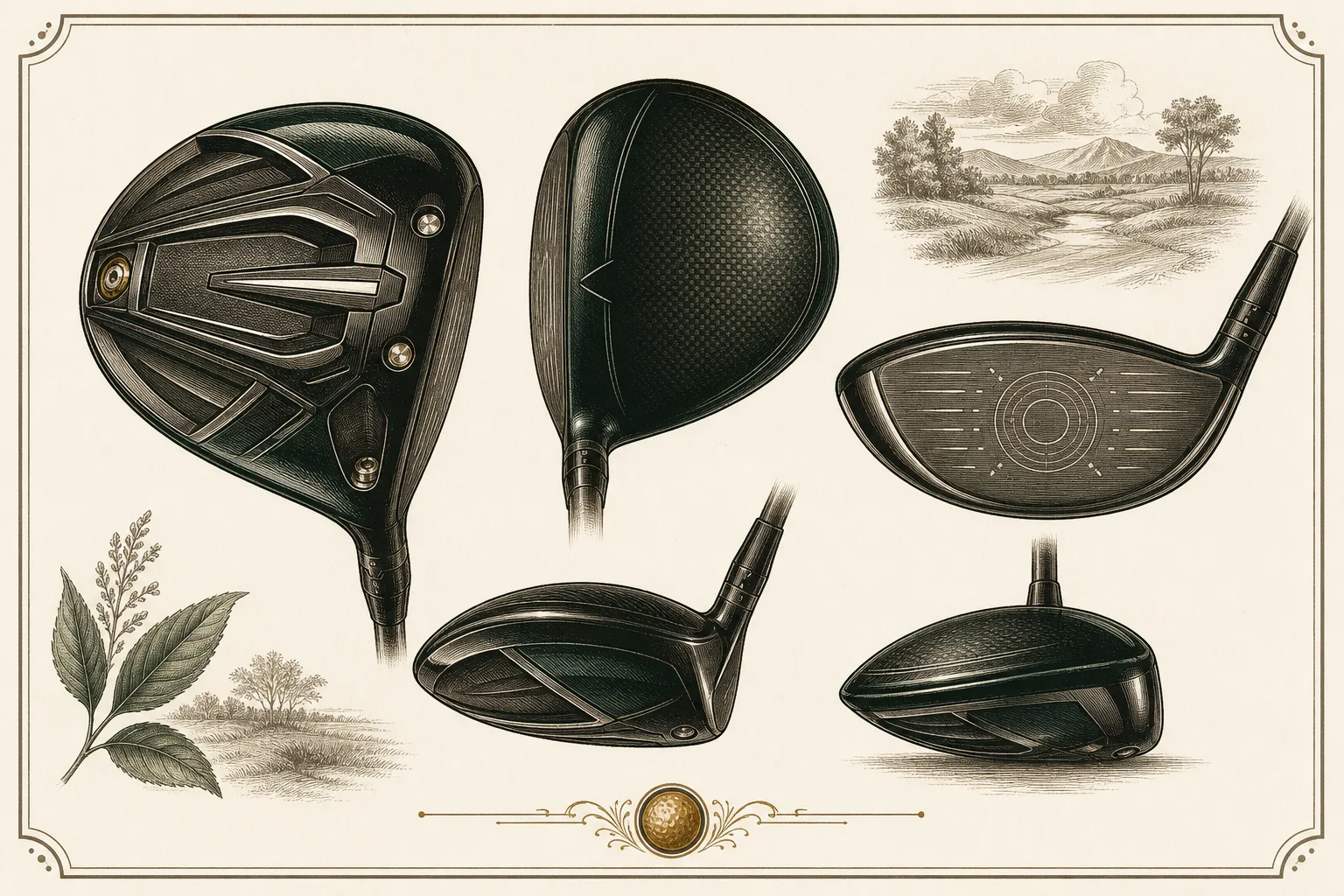
“Refined Jailbreak with a triaxial carbon crown; long and stable. One of the best all-around standard drivers to buy used.”
The Rogue driver arrived in January 2018 as the direct successor to the Great Big Bertha Epic, carrying Jailbreak technology into a second generation: the straight titanium bars behind the face became hourglass-shaped and about 25% lighter, letting Callaway pour the saved weight into stability instead of just speed. MOI jumped to roughly 8,800 g·cm² versus Epic's 8,000 and the XR16's 7,500, aided by a Triaxial Carbon Crown and a Boeing-designed aerodynamic 'Speed Step' on the crown. Offered in 9°, 10.5° and 13.5° with a broad stock-shaft menu (Aldila Synergy, Project X HZRDUS among them), it won a 2018 Golf Digest Hot List Gold Medal and testers generally found it matched Epic's ball speed while being noticeably more forgiving on off-center hits.
No lasting cult, but it is a well-documented, genuinely well-reviewed flagship: a Golf Digest Hot List Gold Medal winner in 2018 and praised across multiple independent outlets (GolfWRX Gear Trials, Golf.com ClubTest, Plugged In Golf, Today's Golfer) as more forgiving than the Epic it replaced. It sits squarely in Callaway's annual product cycle — Epic to Rogue to Rogue Sub Zero to Mavrik — and was superseded within about two years, which is normal turnover, not obscurity.
Fits a broad range of mid-to-low handicap golfers wanting distance with real forgiveness, not just low-handicap workability seekers. Someone chasing extreme adjustability or the absolute lightest swingweight for max clubhead speed, or a player who wants a compact, low-spin tour shape, is better served by the Rogue Sub Zero variant sold alongside it.
Launched into a driver market fighting TaylorMade's M3/M4 (Twist Face), Titleist's 917/915 carryover, and Ping's G400 — all leaning into forgiveness-plus-adjustability messaging. It replaced the 2017 Great Big Bertha Epic on shelves and was itself succeeded by the Rogue Sub Zero/Rogue Draw variants that same cycle, then the 2020 Mavrik line. A modern equivalent in Callaway's own lineage is the Paradym or Ai Smoke driver, which apply the same Jailbreak lineage with AI-optimized faces.
Strong forgiveness for a mainstream-rung driver: the lighter, hourglass Jailbreak bars stiffen the body so more of the impact energy loads the face, and the resulting MOI (~8,800 g·cm²) was a meaningful jump over the prior Epic and XR16. Off-center strikes toward heel and toe hold ball speed well. It is not a max-forgiveness ultralight head, so it lands a step below dedicated game-improvement/max-MOI drivers of its era rather than at the very top of the scale.
Calibrated across the whole catalog — a tour blade scores low here on purpose; it means control, not ease.
Now an 8-year-old model well outside Callaway's warranty/support window, it trades cheaply: realistic 2026 private-party prices for a clean head-only or complete driver run roughly $70–$130 depending on shaft and cosmetic wear, well down from its $499 MSRP. Reconditioned-retail listings (2nd Swing, Global Golf) can show higher graded prices, but that reflects the warranty and grading service, not open-market value.
Reading is one thing — hitting is another. Book a bay and see the numbers for yourself before you buy anywhere.
“Refined Jailbreak with a triaxial carbon crown; long and stable. One of the best all-around standard drivers to buy used.”
The Rogue driver arrived in January 2018 as the direct successor to the Great Big Bertha Epic, carrying Jailbreak technology into a second generation: the straight titanium bars behind the face became hourglass-shaped and about 25% lighter, letting Callaway pour the saved weight into stability instead of just speed. MOI jumped to roughly 8,800 g·cm² versus Epic's 8,000 and the XR16's 7,500, aided by a Triaxial Carbon Crown and a Boeing-designed aerodynamic 'Speed Step' on the crown. Offered in 9°, 10.5° and 13.5° with a broad stock-shaft menu (Aldila Synergy, Project X HZRDUS among them), it won a 2018 Golf Digest Hot List Gold Medal and testers generally found it matched Epic's ball speed while being noticeably more forgiving on off-center hits.
No lasting cult, but it is a well-documented, genuinely well-reviewed flagship: a Golf Digest Hot List Gold Medal winner in 2018 and praised across multiple independent outlets (GolfWRX Gear Trials, Golf.com ClubTest, Plugged In Golf, Today's Golfer) as more forgiving than the Epic it replaced. It sits squarely in Callaway's annual product cycle — Epic to Rogue to Rogue Sub Zero to Mavrik — and was superseded within about two years, which is normal turnover, not obscurity.
Fits a broad range of mid-to-low handicap golfers wanting distance with real forgiveness, not just low-handicap workability seekers. Someone chasing extreme adjustability or the absolute lightest swingweight for max clubhead speed, or a player who wants a compact, low-spin tour shape, is better served by the Rogue Sub Zero variant sold alongside it.
Launched into a driver market fighting TaylorMade's M3/M4 (Twist Face), Titleist's 917/915 carryover, and Ping's G400 — all leaning into forgiveness-plus-adjustability messaging. It replaced the 2017 Great Big Bertha Epic on shelves and was itself succeeded by the Rogue Sub Zero/Rogue Draw variants that same cycle, then the 2020 Mavrik line. A modern equivalent in Callaway's own lineage is the Paradym or Ai Smoke driver, which apply the same Jailbreak lineage with AI-optimized faces.
Strong forgiveness for a mainstream-rung driver: the lighter, hourglass Jailbreak bars stiffen the body so more of the impact energy loads the face, and the resulting MOI (~8,800 g·cm²) was a meaningful jump over the prior Epic and XR16. Off-center strikes toward heel and toe hold ball speed well. It is not a max-forgiveness ultralight head, so it lands a step below dedicated game-improvement/max-MOI drivers of its era rather than at the very top of the scale.
Calibrated across the whole catalog — a tour blade scores low here on purpose; it means control, not ease.
Now an 8-year-old model well outside Callaway's warranty/support window, it trades cheaply: realistic 2026 private-party prices for a clean head-only or complete driver run roughly $70–$130 depending on shaft and cosmetic wear, well down from its $499 MSRP. Reconditioned-retail listings (2nd Swing, Global Golf) can show higher graded prices, but that reflects the warranty and grading service, not open-market value.
Reading is one thing — hitting is another. Book a bay and see the numbers for yourself before you buy anywhere.