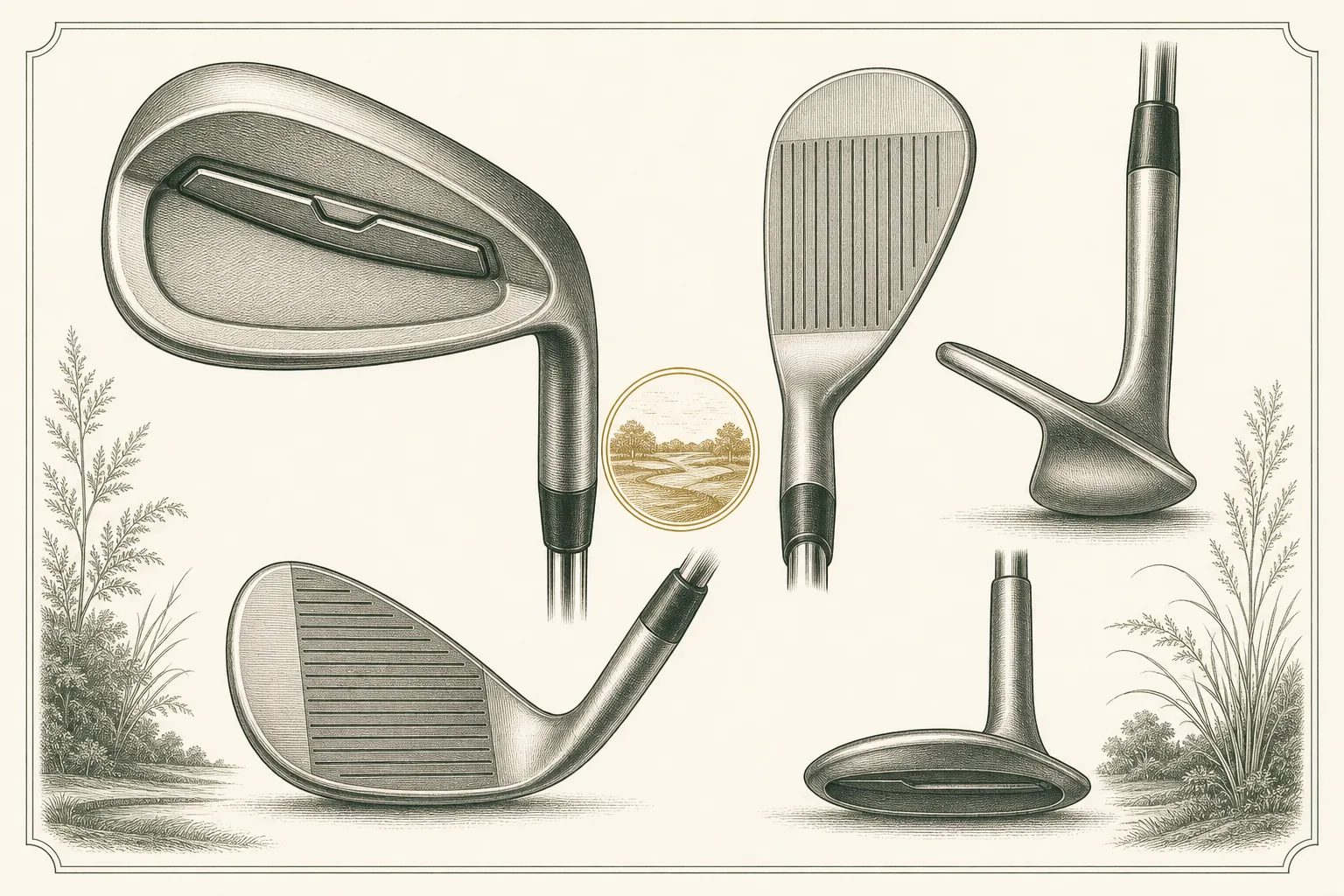
“First Glide (2015) with Gorge grooves and a slightly larger, forgiving-for-a-players'-wedge head; low loft is 47 deg, not 46. Single-flex CFS shaft only, no AWT stock option at this generation. A keep when the grind fits.”
The Glide wedge introduced Ping's 'Gorge' grooves in 2015 -- a design that varies groove geometry by loft rather than using one profile across the whole line. The 47-54 degree wedges use a wider groove radius and a shallower, 16-degree sidewall tuned for full-swing spin and clearing debris, while the 56-60 degree models step up to a steeper 24-degree sidewall aimed at maximizing spin on the shorter pitches and chips those lofts are actually used for. The head is milled and slightly larger than a pure blade-style players' wedge, aimed at players who wanted Ping's tour-level grind options without a raw-blade profile. It shipped with a single stock steel shaft (Ping CFS Wedge) and no separate AWT option, a narrower shaft lineup than later Glide generations offered.
A solidly reviewed, functional first-generation entry in what became a long-running Ping wedge platform, but it carries no cult weight of its own -- it was quickly followed and overshadowed by the Glide 2.0 within about a year, and reviewers discuss it mainly as the wedge that introduced Gorge grooves rather than as a wedge people specifically hunt down today.
An inexpensive, easy-to-find used wedge today: individual Glide 1.0 wedges commonly sell for roughly $25-45 on eBay/SidelineSwap depending on loft, grind and wear, reflecting both its age and the fact it was quickly succeeded by newer Glide generations that get more retailer attention.
Better ball-strikers and low-to-mid handicaps who want tour-style grinds and Gorge-groove spin control without needing multiple sole-width options. A high-handicap player who digs or catches shots heavy would be better served by the wider-sole Glide 2.0 ES that followed it a year later.
Launched into the same wedge generation as Titleist's Vokey SM6 and Cleveland's RTX-3, all competing on loft-specific groove engineering. Ping's Glide platform continued through the 2.0, 3.0, and Forged versions in this same catalog, with the multi-sole-grind idea (ES/WS/SS/TS) arriving in the Glide 2.0 the following year.
Forgiving for a milled players' wedge, not in absolute terms: the head is 'slightly larger and more forgiving' than a pure blade-style tour wedge, per contemporary reviews, and the loft-specific Gorge groove geometry helps maintain spin consistency out of variable lies. It still sits at 5 because it is fundamentally a compact, players-oriented wedge shape with a single sole grind option per loft rather than the wide/multi-sole forgiveness system Ping introduced with the Glide 2.0 the following year.
Calibrated across the whole catalog — a tour blade scores low here on purpose; it means control, not ease.
Reading is one thing — hitting is another. Book a bay and see the numbers for yourself before you buy anywhere.