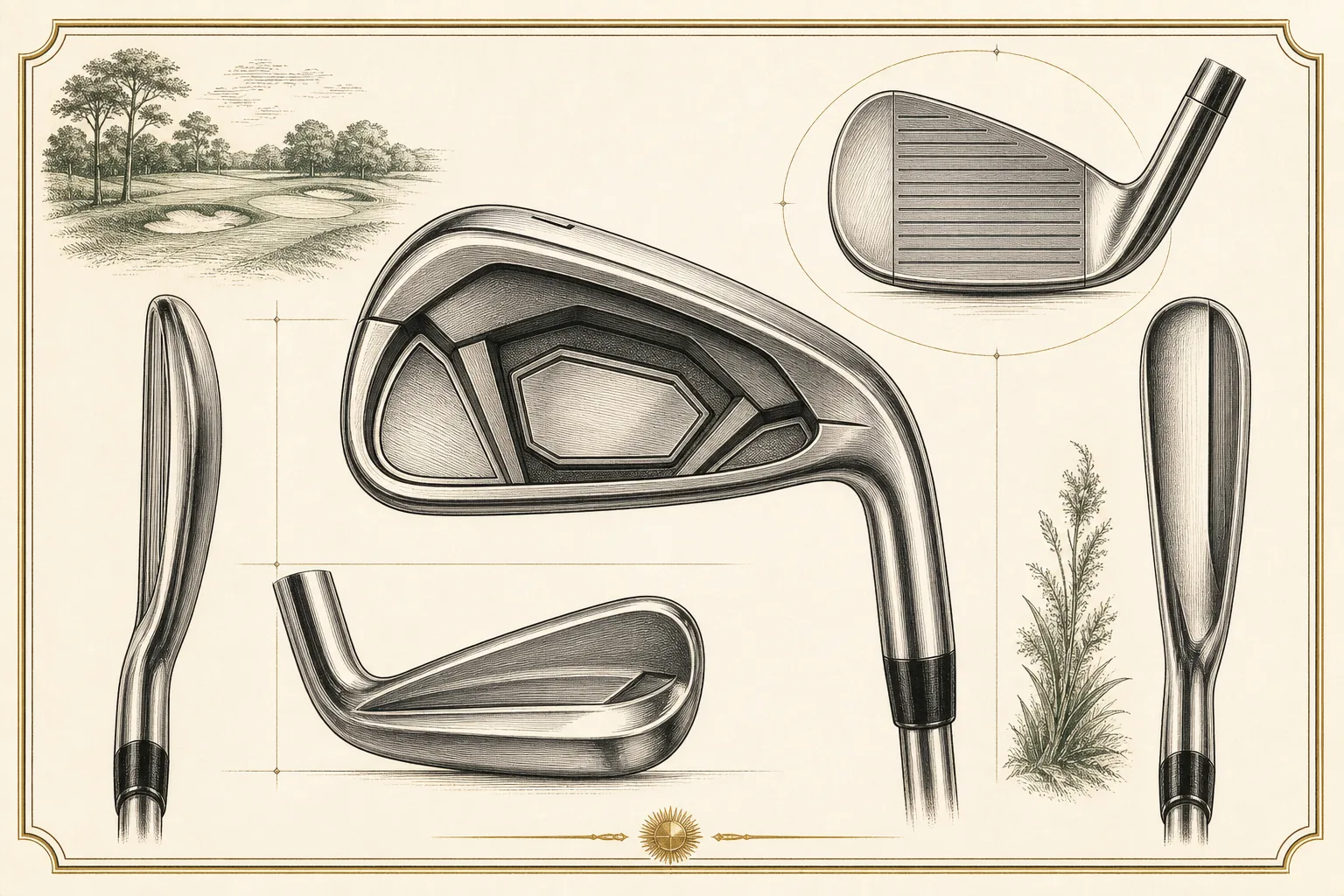
“Compact, thinner-soled players' cavity version of Rogue with traditional lofts and less offset. Steel-only; a forgiving option for better players who want a cleaner look.”
Rogue Pro was Callaway's 2018 answer for better ball-strikers who wanted Rogue-generation technology in a more compact, less forgiving-looking shell: a thinner topline, narrower sole, shallower cavity and less offset than the standard game-improvement Rogue iron, running 3-PW with a True Temper XP 105 steel stock shaft at a $999 set MSRP. It combined Callaway's 360 Face Cup with Variable Face Thickness and introduced an urethane microsphere fill in the cavity to damp vibration and improve sound without stealing face flex. On numbers alone it tested near the top of its field — within a yard of the longest players' iron tested and matching ball speeds from TaylorMade's P790 and Titleist's AP3 — but reviewers flagged the look at address as harder to trust than its performance justified.
A well-executed but unremarkable rung in Callaway's yearly iron refresh: no lawsuit, no signature tour win tied to the model, and reviewer coverage (Today's Golfer, Golfalot, Golf-Info-Guide) centers on solid but unspectacular test numbers rather than any lasting reputation. It was replaced by the Rogue X irons and later Apex/Rogue ST Pro lines within a couple of years, following Callaway's normal churn.
Fits low-to-mid handicap players who want speed and some workability without a full blade's demands — reviewers specifically noted it performed well on the course despite address-look concerns. A high handicapper wanting maximum forgiveness and a confidence-inspiring wide sole should look at the standard Rogue iron instead.
Launched into a 2018 players'-distance iron market fighting TaylorMade's P790, Titleist's AP3, and Mizuno's JPX900 Forged, all chasing the same 'distance iron that still looks decent' brief. It sat alongside the standard, more forgiving Rogue iron in Callaway's 2018 range and was succeeded by the Rogue X and eventually the Apex/Rogue ST Pro lines as Callaway kept iterating its players'-distance shelf.
Positioned as a compact players'-distance iron rather than a true game-improvement club: the shallower cavity, thinner topline and reduced offset trade away some forgiveness for workability and a cleaner look, while the urethane microsphere fill and 360 Face Cup still deliver real ball speed on center strikes. This lands it in the same forgiveness tier as other players'-cavity irons — usable across a range of decent ball-strikers but demanding more centered contact than a true game-improvement iron.
Calibrated across the whole catalog — a tour blade scores low here on purpose; it means control, not ease.
Realistic 2026 private-party pricing for a clean 3-PW/4-PW steel set runs roughly $180–$300 depending on shaft wear and grooves, well down from the $999 retail; reconditioned-retail listings will show notably higher graded prices that do not reflect open-market resale.
Reading is one thing — hitting is another. Book a bay and see the numbers for yourself before you buy anywhere.
“Compact, thinner-soled players' cavity version of Rogue with traditional lofts and less offset. Steel-only; a forgiving option for better players who want a cleaner look.”
Rogue Pro was Callaway's 2018 answer for better ball-strikers who wanted Rogue-generation technology in a more compact, less forgiving-looking shell: a thinner topline, narrower sole, shallower cavity and less offset than the standard game-improvement Rogue iron, running 3-PW with a True Temper XP 105 steel stock shaft at a $999 set MSRP. It combined Callaway's 360 Face Cup with Variable Face Thickness and introduced an urethane microsphere fill in the cavity to damp vibration and improve sound without stealing face flex. On numbers alone it tested near the top of its field — within a yard of the longest players' iron tested and matching ball speeds from TaylorMade's P790 and Titleist's AP3 — but reviewers flagged the look at address as harder to trust than its performance justified.
A well-executed but unremarkable rung in Callaway's yearly iron refresh: no lawsuit, no signature tour win tied to the model, and reviewer coverage (Today's Golfer, Golfalot, Golf-Info-Guide) centers on solid but unspectacular test numbers rather than any lasting reputation. It was replaced by the Rogue X irons and later Apex/Rogue ST Pro lines within a couple of years, following Callaway's normal churn.
Fits low-to-mid handicap players who want speed and some workability without a full blade's demands — reviewers specifically noted it performed well on the course despite address-look concerns. A high handicapper wanting maximum forgiveness and a confidence-inspiring wide sole should look at the standard Rogue iron instead.
Launched into a 2018 players'-distance iron market fighting TaylorMade's P790, Titleist's AP3, and Mizuno's JPX900 Forged, all chasing the same 'distance iron that still looks decent' brief. It sat alongside the standard, more forgiving Rogue iron in Callaway's 2018 range and was succeeded by the Rogue X and eventually the Apex/Rogue ST Pro lines as Callaway kept iterating its players'-distance shelf.
Positioned as a compact players'-distance iron rather than a true game-improvement club: the shallower cavity, thinner topline and reduced offset trade away some forgiveness for workability and a cleaner look, while the urethane microsphere fill and 360 Face Cup still deliver real ball speed on center strikes. This lands it in the same forgiveness tier as other players'-cavity irons — usable across a range of decent ball-strikers but demanding more centered contact than a true game-improvement iron.
Calibrated across the whole catalog — a tour blade scores low here on purpose; it means control, not ease.
Realistic 2026 private-party pricing for a clean 3-PW/4-PW steel set runs roughly $180–$300 depending on shaft wear and grooves, well down from the $999 retail; reconditioned-retail listings will show notably higher graded prices that do not reflect open-market resale.
Reading is one thing — hitting is another. Book a bay and see the numbers for yourself before you buy anywhere.