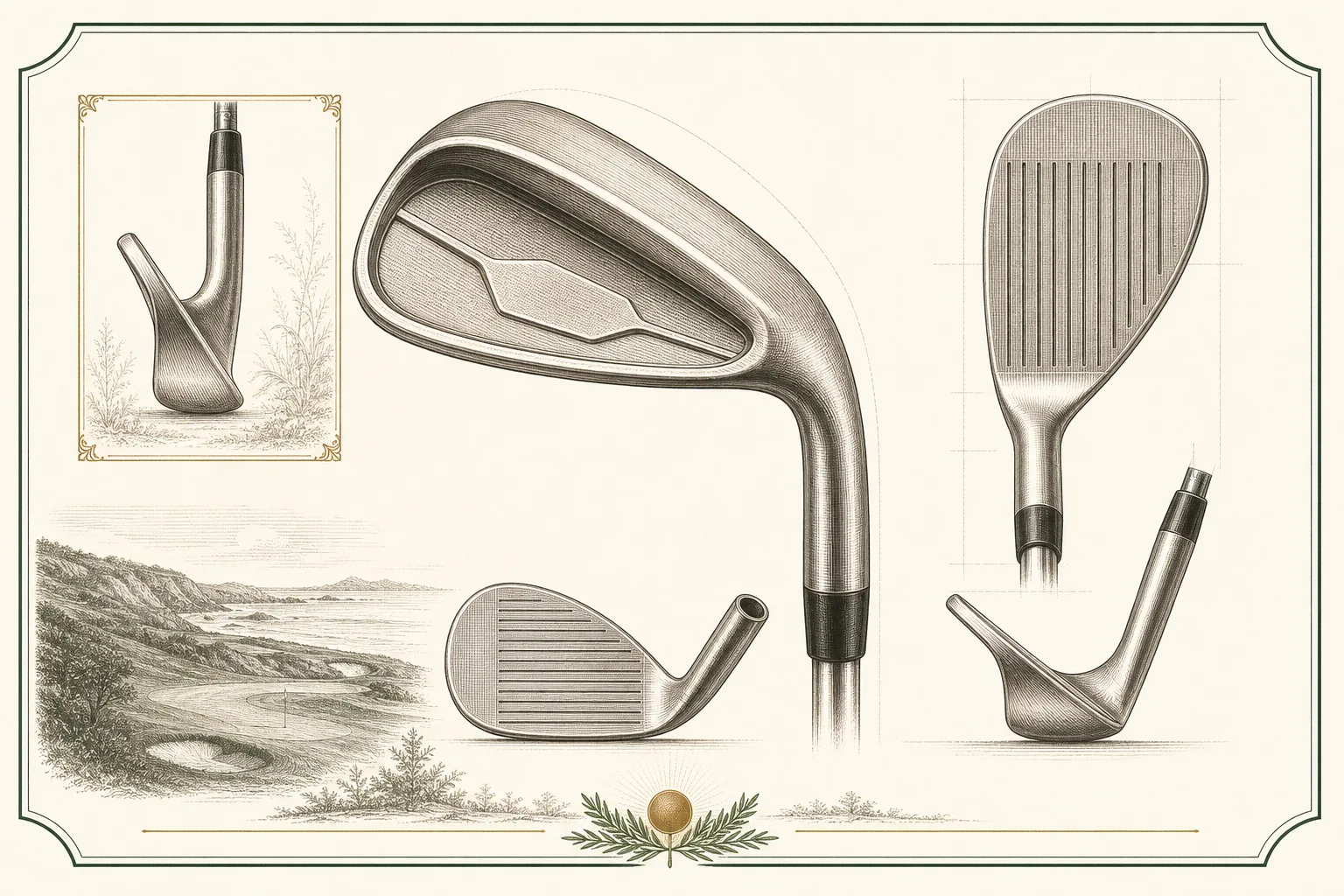
The Tour-W was Ping's 2005 wedge, built around a machined face and grooves paired with a compact teardrop head - a shift toward a more tour-focused, "classy" look after the bulkier Eye2/Tour wedges of the prior decade. A tungsten toe weight and a small custom-tuning port in the back raised the head's moment of inertia for extra stability and feel without bulking up the shape, and the wedge was offered across an unusually broad spread of loft/bounce combinations, from 47/10 up through 60/6, 60/8 and 60/10. Its brushed-silver chrome finish was designed to cut glare, and Ping's tour staff - including Lee Westwood, who won the British Masters gaming it - carried it on tour, giving the release real validation at launch.
Golf Monthly and Today's Golfer both praised it as versatile and spin-generating "in any conditions," and it carried genuine tour pedigree via Lee Westwood's British Masters win, but there is no scarcity or forum-hunt narrative around it today - a well-regarded, mid-2000s Ping release rather than a cult object.
Reviewers specifically called it a wedge that "appeals to a wide range of players, from scratch to higher handicappers" thanks to its slightly larger head size; still, a golfer wanting today's wide-sole turf-friendly bounce options or Ping's later multi-grind fitting system (introduced with Tour Gorge and Glide) will get more precise fitting from those newer lines.
Released in the mid-2000s alongside Titleist's Vokey 200-series and Cleveland's CG10/11 wedges; Ping followed it with the Tour Gorge (2012) and then the four-grind Glide line (2014), each generation replacing Tour-W's single-sole approach with more fitted sole options.
The tungsten toe weight and rear tuning port raise MOI beyond a pure blade-style wedge, and reviewers noted the slightly larger head "inspires confidence" for higher-handicap players without looking cumbersome; still a machined, tour-oriented wedge rather than a wide-sole game-improvement design, so mis-hits from heavy rough or thin lies lose more than on a modern max-forgiveness wedge.
Calibrated across the whole catalog — a tour blade scores low here on purpose; it means control, not ease.
Two decades old and long superseded, used Tour-W wedges sell cheaply today - eBay listings commonly run roughly $40-$60 per club including shipping depending on loft and condition, consistent with a well-liked but outdated mid-2000s wedge rather than a collectible.
Reading is one thing — hitting is another. Book a bay and see the numbers for yourself before you buy anywhere.
The Tour-W was Ping's 2005 wedge, built around a machined face and grooves paired with a compact teardrop head - a shift toward a more tour-focused, "classy" look after the bulkier Eye2/Tour wedges of the prior decade. A tungsten toe weight and a small custom-tuning port in the back raised the head's moment of inertia for extra stability and feel without bulking up the shape, and the wedge was offered across an unusually broad spread of loft/bounce combinations, from 47/10 up through 60/6, 60/8 and 60/10. Its brushed-silver chrome finish was designed to cut glare, and Ping's tour staff - including Lee Westwood, who won the British Masters gaming it - carried it on tour, giving the release real validation at launch.
Golf Monthly and Today's Golfer both praised it as versatile and spin-generating "in any conditions," and it carried genuine tour pedigree via Lee Westwood's British Masters win, but there is no scarcity or forum-hunt narrative around it today - a well-regarded, mid-2000s Ping release rather than a cult object.
Reviewers specifically called it a wedge that "appeals to a wide range of players, from scratch to higher handicappers" thanks to its slightly larger head size; still, a golfer wanting today's wide-sole turf-friendly bounce options or Ping's later multi-grind fitting system (introduced with Tour Gorge and Glide) will get more precise fitting from those newer lines.
Released in the mid-2000s alongside Titleist's Vokey 200-series and Cleveland's CG10/11 wedges; Ping followed it with the Tour Gorge (2012) and then the four-grind Glide line (2014), each generation replacing Tour-W's single-sole approach with more fitted sole options.
The tungsten toe weight and rear tuning port raise MOI beyond a pure blade-style wedge, and reviewers noted the slightly larger head "inspires confidence" for higher-handicap players without looking cumbersome; still a machined, tour-oriented wedge rather than a wide-sole game-improvement design, so mis-hits from heavy rough or thin lies lose more than on a modern max-forgiveness wedge.
Calibrated across the whole catalog — a tour blade scores low here on purpose; it means control, not ease.
Two decades old and long superseded, used Tour-W wedges sell cheaply today - eBay listings commonly run roughly $40-$60 per club including shipping depending on loft and condition, consistent with a well-liked but outdated mid-2000s wedge rather than a collectible.
Reading is one thing — hitting is another. Book a bay and see the numbers for yourself before you buy anywhere.