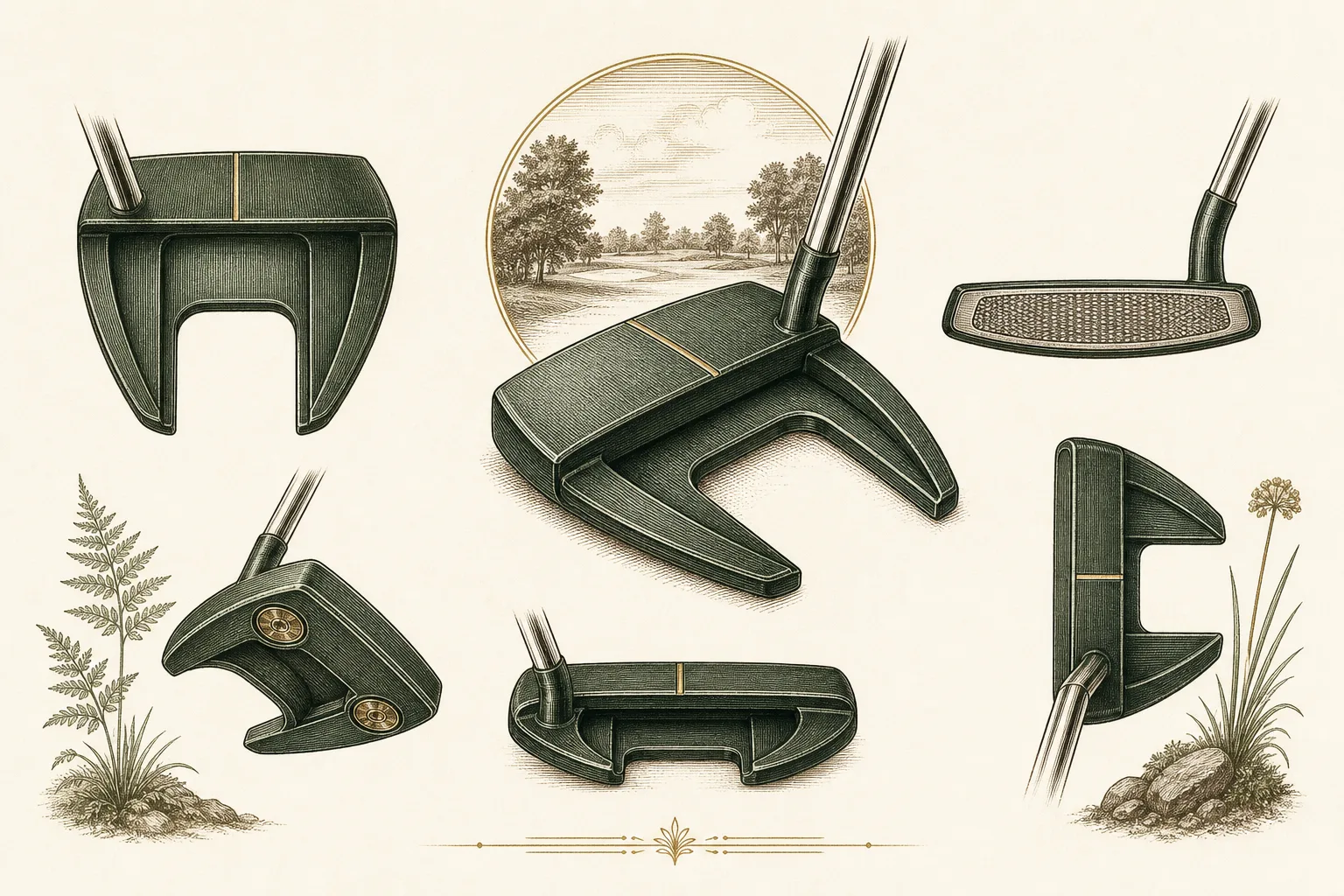
“A 5.5-inch face oversize mallet, lie-adjustable across a full 16-degree range and weight-adjustable over 200 grams. Very high MOI and face-balanced, ideal for a straight stroke and maximum forgiveness.”
The RX4 sits in the middle of Cure's three-model RX Series, stepping the face up to 5.5 inches and widening the adjustable-weight range to more than 200 grams (349g to 603g), which pushes MOI from about 6,900 up to 14,600 depending on how a fitter loads it. Like its siblings it's machined from aircraft-grade aluminum with a fully adjustable hosel (16 degrees of lie range, 8 flat to 8 upright) and Cure's toe/heel disc weight system. It's the brand's volume seller in the range — bigger and more stable than the RX3, not quite the flagship-scale RX5 — aimed at putting the highest MOI possible into a head that still looks and plays like a normal-sized mallet.
Same story as the rest of the RX line: real, repeated trade-press coverage (Golf Tips Buyer's Guide, Golf Monthly forums, ColoradoGolfBlog) and a loyal niche following among players chasing maximum stability, but no broader cultural cachet or collector demand. It is a respected specialist tool, not a cult object.
Ideal for a mid-to-high handicap or any player who has decided face-balanced, maximum-forgiveness putting is the priority over feel or a compact look — the head is visibly larger than a standard mallet. Not suited to a player who wants to manipulate face rotation through the stroke or prefers a blade's smaller footprint.
Part of the same mid-2010s high-MOI mallet trend as the RX3/RX5, competing indirectly with Odyssey Jailbird/Ten and TaylorMade Spider models that dominated that shelf space with bigger marketing budgets and tour pedigree Cure never had.
The 200-gram-plus adjustable range and MOI ceiling of 14,600 put the RX4 well ahead of a standard mallet putter (most sit in the 3,000-5,500 MOI range) on twist-resistance for off-center strikes. It trails only the larger-faced RX5 within Cure's own lineup, and Cure markets the entire RX Series explicitly on forgiveness rather than feel or workability.
Calibrated across the whole catalog — a tour blade scores low here on purpose; it means control, not ease.
Expect roughly $110-170 in 2026 for a clean used example against a $279 original MSRP — a small step up from the RX3 given the larger head is generally the more sought-after configuration within the line, but still a thin resale market compared to major mallet brands.
Reading is one thing — hitting is another. Book a bay and see the numbers for yourself before you buy anywhere.
“A 5.5-inch face oversize mallet, lie-adjustable across a full 16-degree range and weight-adjustable over 200 grams. Very high MOI and face-balanced, ideal for a straight stroke and maximum forgiveness.”
The RX4 sits in the middle of Cure's three-model RX Series, stepping the face up to 5.5 inches and widening the adjustable-weight range to more than 200 grams (349g to 603g), which pushes MOI from about 6,900 up to 14,600 depending on how a fitter loads it. Like its siblings it's machined from aircraft-grade aluminum with a fully adjustable hosel (16 degrees of lie range, 8 flat to 8 upright) and Cure's toe/heel disc weight system. It's the brand's volume seller in the range — bigger and more stable than the RX3, not quite the flagship-scale RX5 — aimed at putting the highest MOI possible into a head that still looks and plays like a normal-sized mallet.
Same story as the rest of the RX line: real, repeated trade-press coverage (Golf Tips Buyer's Guide, Golf Monthly forums, ColoradoGolfBlog) and a loyal niche following among players chasing maximum stability, but no broader cultural cachet or collector demand. It is a respected specialist tool, not a cult object.
Ideal for a mid-to-high handicap or any player who has decided face-balanced, maximum-forgiveness putting is the priority over feel or a compact look — the head is visibly larger than a standard mallet. Not suited to a player who wants to manipulate face rotation through the stroke or prefers a blade's smaller footprint.
Part of the same mid-2010s high-MOI mallet trend as the RX3/RX5, competing indirectly with Odyssey Jailbird/Ten and TaylorMade Spider models that dominated that shelf space with bigger marketing budgets and tour pedigree Cure never had.
The 200-gram-plus adjustable range and MOI ceiling of 14,600 put the RX4 well ahead of a standard mallet putter (most sit in the 3,000-5,500 MOI range) on twist-resistance for off-center strikes. It trails only the larger-faced RX5 within Cure's own lineup, and Cure markets the entire RX Series explicitly on forgiveness rather than feel or workability.
Calibrated across the whole catalog — a tour blade scores low here on purpose; it means control, not ease.
Expect roughly $110-170 in 2026 for a clean used example against a $279 original MSRP — a small step up from the RX3 given the larger head is generally the more sought-after configuration within the line, but still a thin resale market compared to major mallet brands.
Reading is one thing — hitting is another. Book a bay and see the numbers for yourself before you buy anywhere.