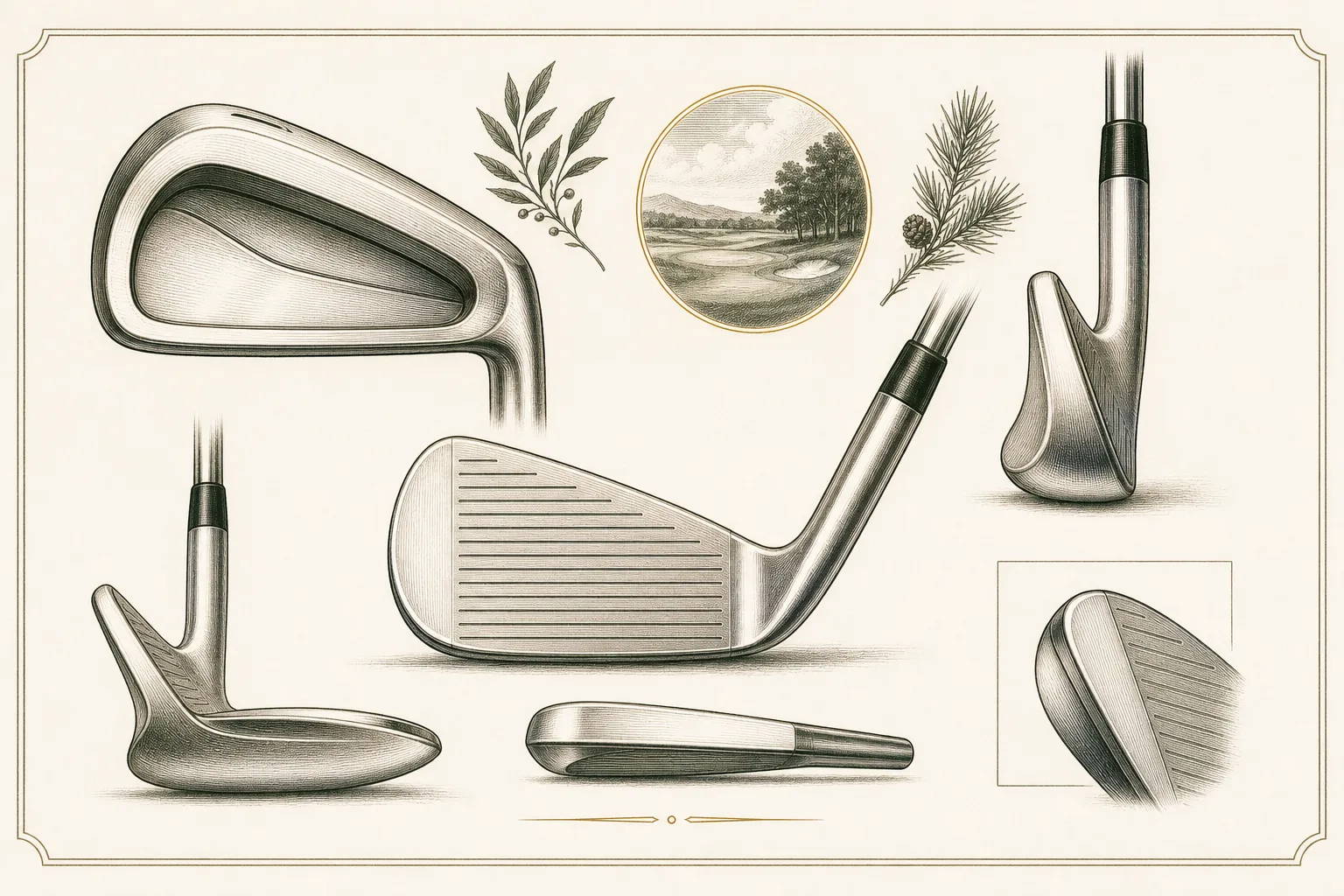
“The cut-muscle cavity that gave a hair of forgiveness to a blade profile. A rung-2 players' cavity beloved for its feel and workability.”
The MP-32 (2004) was Mizuno's answer to a hard question: how do you give a good player the buttery feel of a blade without all the punishment? It introduced the 'Cut Muscle' design — a muscle-back profile with a section milled out of the back to push the center of gravity roughly 25% deeper than the pure-blade MP-33 it sat beside in the line. Grain Flow Forged from a single billet of 1025 mild carbon steel in Hiroshima, it kept the soft, dense impact feel Mizuno is known for while adding just enough stability to be playable in a compact head. It landed as the sweet spot of the MP range — more workable than a cavity, more playable than a blade — and its sole grind became the template for the MP irons that followed.
Twenty years on, players still actively hunt clean sets: recurring GolfWRX threads ('MP-32 — why are they so good?!'), a 4.5/5 across ~187 user reviews on golfreview.com, and repeated inclusion among the greatest Mizuno blade-style irons ever made. Danny Lee was still gaming a set on the PGA Tour as late as 2019, sourced from Luke Donald's personal tour-van stash — a story that keeps the model's legend alive.
Low-to-mid handicaps (roughly 0-10) with consistent ball-striking and enough speed to launch a ~24-degree 4-iron. The reward is shot-shaping control and premium feel. A mid-to-high handicap chasing forgiveness or extra distance should not buy this today — a modern game-improvement or players-distance iron will be far kinder and longer.
At launch it competed against Titleist's 690.MB/CB, the Callaway X-Tour and TaylorMade's mid-2000s forged players' irons, slotting between Mizuno's own MP-33 blade and MP-30 cavity. Its Cut Muscle sole profile carried directly into the MP-60/MP-62 that succeeded it. A modern equivalent is the Mizuno Pro 243/245 — same design brief with today's stronger lofts and slightly larger sweet spots.
Forgiving FOR ITS CLASS, not in absolute terms. The Cut Muscle cavity sits its CG ~25% deeper than the MP-33 blade, so mis-hits hold line and distance better than a true muscle-back — but this is still a compact head with a thin sole, minimal offset and a small sweet spot. Thin and toe strikes are punished with lost distance and feel; it demands a repeatable center-face strike. A 5 means 'the most forgiving a players' iron of this shape gets,' not 'easy to hit.'
Calibrated across the whole catalog — a tour blade scores low here on purpose; it means control, not ease.
Clean 3-PW or 4-PW sets typically run about $200-415 in 2026 depending on shaft, flex and wear (original retail roughly $900). It holds value unusually well for a 20-year-old iron because feel-chaser demand is steady; rust on the raw-ish carbon-steel heads and worn grooves knock value down, while premium/rare shafts (Dynamic Gold X100, Project X) push it up. Reconditioned-retail listings run higher because they are graded/warrantied store prices.
The Legends Rack
"Nothing feels like a Mizuno" was built on these. Grain-flow forged in Hiroshima, worshipped on forums for twenty years. The MP-33 may be the most beloved blade of the modern era. Who'll love it: feel obsessives — hand it over and count to three before the sigh.
Who it suitsBetter players
Reading is one thing — hitting is another. Book a bay and see the numbers for yourself before you buy anywhere.
“The cut-muscle cavity that gave a hair of forgiveness to a blade profile. A rung-2 players' cavity beloved for its feel and workability.”
The MP-32 (2004) was Mizuno's answer to a hard question: how do you give a good player the buttery feel of a blade without all the punishment? It introduced the 'Cut Muscle' design — a muscle-back profile with a section milled out of the back to push the center of gravity roughly 25% deeper than the pure-blade MP-33 it sat beside in the line. Grain Flow Forged from a single billet of 1025 mild carbon steel in Hiroshima, it kept the soft, dense impact feel Mizuno is known for while adding just enough stability to be playable in a compact head. It landed as the sweet spot of the MP range — more workable than a cavity, more playable than a blade — and its sole grind became the template for the MP irons that followed.
Twenty years on, players still actively hunt clean sets: recurring GolfWRX threads ('MP-32 — why are they so good?!'), a 4.5/5 across ~187 user reviews on golfreview.com, and repeated inclusion among the greatest Mizuno blade-style irons ever made. Danny Lee was still gaming a set on the PGA Tour as late as 2019, sourced from Luke Donald's personal tour-van stash — a story that keeps the model's legend alive.
Low-to-mid handicaps (roughly 0-10) with consistent ball-striking and enough speed to launch a ~24-degree 4-iron. The reward is shot-shaping control and premium feel. A mid-to-high handicap chasing forgiveness or extra distance should not buy this today — a modern game-improvement or players-distance iron will be far kinder and longer.
At launch it competed against Titleist's 690.MB/CB, the Callaway X-Tour and TaylorMade's mid-2000s forged players' irons, slotting between Mizuno's own MP-33 blade and MP-30 cavity. Its Cut Muscle sole profile carried directly into the MP-60/MP-62 that succeeded it. A modern equivalent is the Mizuno Pro 243/245 — same design brief with today's stronger lofts and slightly larger sweet spots.
Forgiving FOR ITS CLASS, not in absolute terms. The Cut Muscle cavity sits its CG ~25% deeper than the MP-33 blade, so mis-hits hold line and distance better than a true muscle-back — but this is still a compact head with a thin sole, minimal offset and a small sweet spot. Thin and toe strikes are punished with lost distance and feel; it demands a repeatable center-face strike. A 5 means 'the most forgiving a players' iron of this shape gets,' not 'easy to hit.'
Calibrated across the whole catalog — a tour blade scores low here on purpose; it means control, not ease.
Clean 3-PW or 4-PW sets typically run about $200-415 in 2026 depending on shaft, flex and wear (original retail roughly $900). It holds value unusually well for a 20-year-old iron because feel-chaser demand is steady; rust on the raw-ish carbon-steel heads and worn grooves knock value down, while premium/rare shafts (Dynamic Gold X100, Project X) push it up. Reconditioned-retail listings run higher because they are graded/warrantied store prices.
The Legends Rack
"Nothing feels like a Mizuno" was built on these. Grain-flow forged in Hiroshima, worshipped on forums for twenty years. The MP-33 may be the most beloved blade of the modern era. Who'll love it: feel obsessives — hand it over and count to three before the sigh.
Who it suitsBetter players
Reading is one thing — hitting is another. Book a bay and see the numbers for yourself before you buy anywhere.