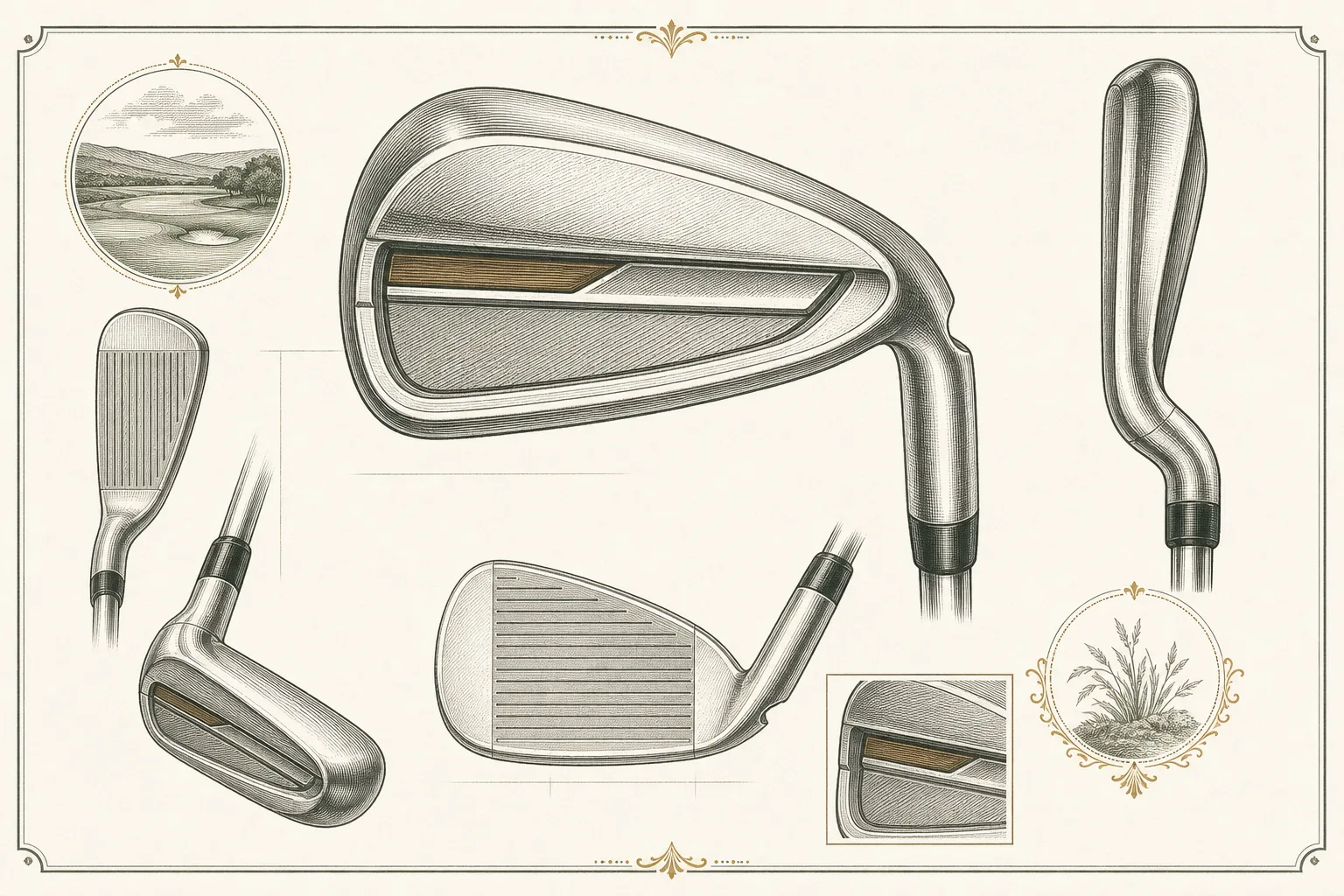
“Rung-1 super-game-improvement hollow-body. Standard-spec 7-iron is 28 deg - the 29.5 deg number widely quoted online is the optional stronger Power Spec loft, not stock. Sold 4-9, PW, UW, SW. Maximum launch and carry for slower swings; among the easiest Ping irons of its era to hit.”
The G700 was an all-new construction for Ping in 2018 -- its first true hollow-body iron and, at launch, the largest, most distance-oriented iron in its lineup, taking over that role from the G-Max. A 17-4 stainless-steel hollow body wraps around a C300 maraging-steel face for a thin, hot hitting surface, finished in HydroPearl coating to reduce turf drag and grass/water pickup. Despite the hollow-body build, Ping kept the topline clean enough that reviewers said it looks closer to a muscleback from behind than a visible-cavity GI iron like its own iBlade. Head-to-head testing found 3-4 mph more ball speed and about 2.5 degrees higher launch than a standard cavity-back, worth roughly 10 extra yards of carry -- numbers Ping's marketing and outlets like MyGolfSpy and Golf.com both reported.
It earns 'notable' on a real engineering milestone -- Ping's first genuine hollow-body iron construction, replacing the G-Max as the distance flagship -- and strong, consistent press coverage (Golf.com ClubTest 2018, MyGolfSpy, Golf Monthly, Plugged In Golf all reviewed it favorably). It never crossed into cult territory: no scarcity, no tour-legend story, and it was itself superseded by the G710 within about two years as part of Ping's normal iron refresh cycle.
Storefront-graded listings (2nd Swing, GlobalGolf, SidelineSwap) show partial or full used sets running roughly $430-640 depending on configuration, shaft and condition -- solid retained value for a 2018 iron given the modern $160-175/club (steel/graphite) launch MSRP implies a full 8-club steel set near $1,280 new. Private-party eBay listings for partial sets typically run somewhat lower than the graded-storefront numbers; a complete, clean steel set in the $350-550 range is a realistic private-sale expectation.
Slower swing speeds (Ping's own fitting guidance points to sub-70 mph 7-iron speeds) and higher handicappers who want maximum launch, carry and forgiveness with minimal shot-shaping demands. A single-digit handicapper who wants iron-like feedback and workability should look at Ping's iBlade or Blueprint irons instead -- the G700's hollow-body construction is built to hide mis-hits, not reward precision.
Launched to compete with distance-iron rivals like the Callaway Rogue and TaylorMade M4/M6 in the 2018-2019 super-game-improvement wave. It replaced the G-Max as Ping's largest iron and was itself replaced by the G710 (2019) and later the G425/G430 iron lines, all inheriting the hollow-body-face-insert idea the G700 established for the brand.
A genuine super-game-improvement iron: hollow-body construction with a thin, hot maraging-steel face and a low, deep CG built specifically to launch the ball high with minimal effort, and independent testing confirmed real gains in ball speed and launch angle versus a standard cavity-back. It scores a 9, just short of the very top, because the hollow-body cavity trades a little sound/feel consistency on mis-hits for its distance and launch gains -- true blades-and-players' irons sit far lower, and the very largest max-GI offerings edge it out on sheer forgiveness.
Calibrated across the whole catalog — a tour blade scores low here on purpose; it means control, not ease.
Reading is one thing — hitting is another. Book a bay and see the numbers for yourself before you buy anywhere.