“Rung-1 super-game-improvement hollow-body - actually sold as a 5-iron-through-PW/SW set; there's no stock 4-iron, Ping pairs it with a crossover hybrid up top. 7-iron loft eased back to 28 deg after several generations of loft creep. Replaced by the G740 in March 2026.”
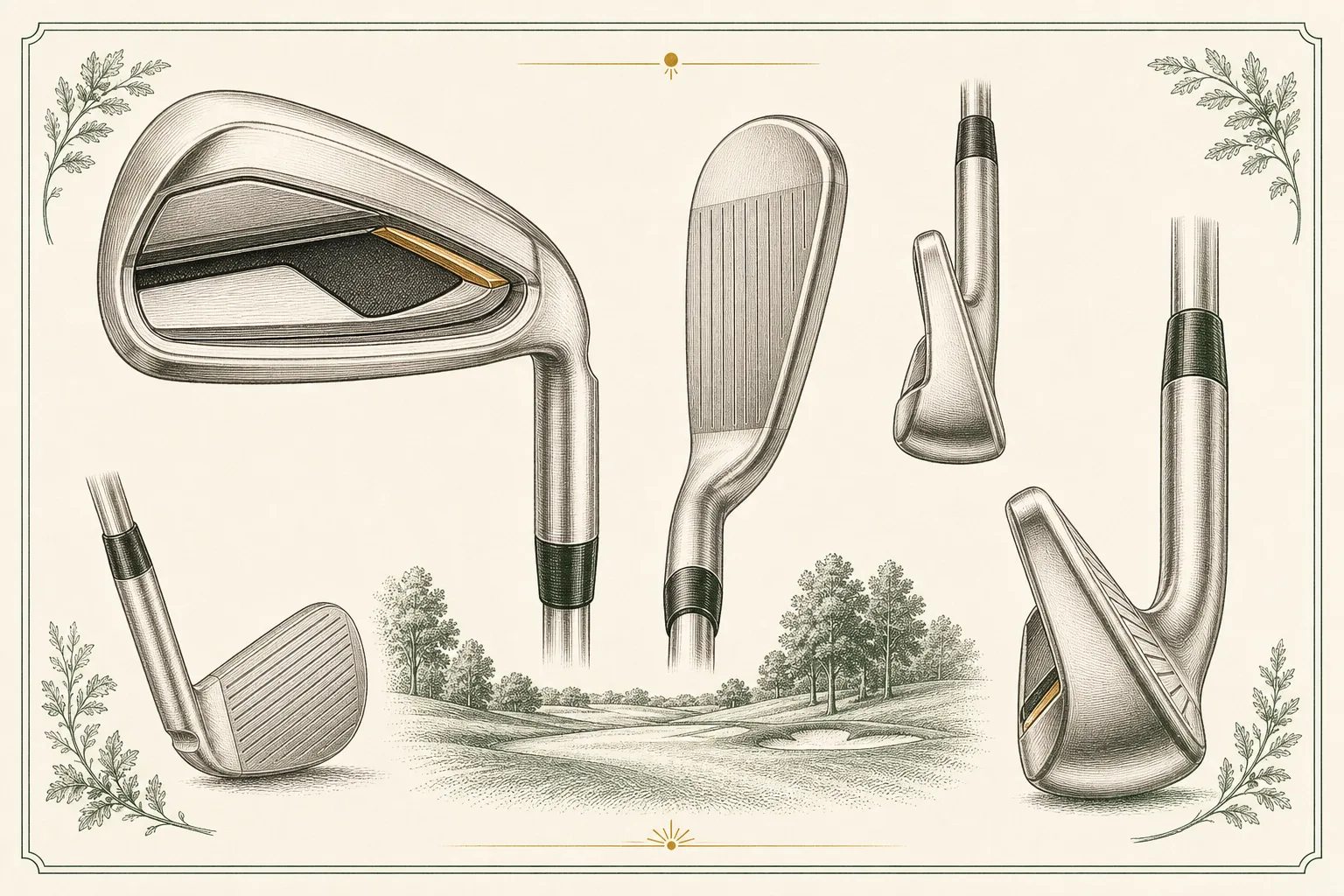
Released in 2024, the G730 is Ping's super-game-improvement iron and, per CEO John K. Solheim, the longest and most forgiving iron in the lineup. It is a hollow-body club built around a 'hyper' 17-4 stainless face that Ping thinned via advanced heat treatment so it flexes harder at impact for more ball speed; behind it, a multiple-flex-zone PurFlex cavity badge controls that flexing to preserve speed across the face. The head is large with a wide sole and generous offset to inspire confidence and get the ball airborne easily, and the lofts are aggressively strong — 1.5 to 4 degrees stronger than the G710 it replaces — which drives the distance headline. It is sold as a 5-PW/SW set with no stock 4-iron: a distance-and-launch machine aimed at higher handicaps who need maximum help.
An honest commodity in the best sense: a mass-market super-game-improvement iron bought purely for function, superseded on Ping's roughly two-year G-cadence. It reviews well (Plugged In Golf, Golf Monthly, MyGolfSpy) and its 'longest Ping iron ever' hook got press, but there is no scarcity, lore or collectibility — it sells in volume to players who want distance and forgiveness and will trade it in when the next G arrives.
Built for high handicaps to beginners (roughly 15 and up) and moderate swing speeds who struggle with consistent contact and getting the ball in the air. The reward is easy height, forgiveness on mis-hits and long carry. Who should not buy it: better ball-strikers wanting feel or control, and anyone bothered by strong lofts closing gaps at the short end or by the chunky profile — a players'-distance iron like the i530 suits them better.
Launched in 2024 into the super-game-improvement field against the TaylorMade Stealth/Qi HL, Callaway Paradym/Elyte HL, Cleveland Launcher XL and Cobra's max-forgiveness irons. It replaces the G710 as Ping's SGI model and sits below the G440 game-improvement iron in the range. Its distance comes from strong lofts plus a thin flexing face, so like all modern SGI irons it flies far but with the weak-loft-at-the-top gapping and lower spin that category implies.
About as forgiving as an iron gets — the top of the whole-catalog scale. The hollow body, wide sole, deep low/back CG, high MOI and thin flexing face mean even toe and thin strikes hold launch and distance remarkably well, and the wide cambered sole resists digging from imperfect lies. Ping itself markets it as the most forgiving iron it makes. The trade-offs are the SGI trade-offs: a large, offset-heavy look at address and effectively no workability — you cannot shape shots, and better players find it one-dimensional.
Calibrated across the whole catalog — a tour blade scores low here on purpose; it means control, not ease.
As a current (2024) mass-market SGI iron, used supply is growing and depreciation is real. Reconditioned-retail and dealer used listings (2nd Swing, GlobalGolf, Callaway Pre-Owned) run broadly ~$700-$1,100 depending on set size and shaft against ~$1,380 new; realistic private-party value in 2026 is lower, roughly $500-$800 for a clean 5-PW set. It will depreciate faster than the players' models as the next G-series lands — buy it to play, not to hold.
Reading is one thing — hitting is another. Book a bay and see the numbers for yourself before you buy anywhere.
“Rung-1 super-game-improvement hollow-body - actually sold as a 5-iron-through-PW/SW set; there's no stock 4-iron, Ping pairs it with a crossover hybrid up top. 7-iron loft eased back to 28 deg after several generations of loft creep. Replaced by the G740 in March 2026.”
Released in 2024, the G730 is Ping's super-game-improvement iron and, per CEO John K. Solheim, the longest and most forgiving iron in the lineup. It is a hollow-body club built around a 'hyper' 17-4 stainless face that Ping thinned via advanced heat treatment so it flexes harder at impact for more ball speed; behind it, a multiple-flex-zone PurFlex cavity badge controls that flexing to preserve speed across the face. The head is large with a wide sole and generous offset to inspire confidence and get the ball airborne easily, and the lofts are aggressively strong — 1.5 to 4 degrees stronger than the G710 it replaces — which drives the distance headline. It is sold as a 5-PW/SW set with no stock 4-iron: a distance-and-launch machine aimed at higher handicaps who need maximum help.
An honest commodity in the best sense: a mass-market super-game-improvement iron bought purely for function, superseded on Ping's roughly two-year G-cadence. It reviews well (Plugged In Golf, Golf Monthly, MyGolfSpy) and its 'longest Ping iron ever' hook got press, but there is no scarcity, lore or collectibility — it sells in volume to players who want distance and forgiveness and will trade it in when the next G arrives.
Built for high handicaps to beginners (roughly 15 and up) and moderate swing speeds who struggle with consistent contact and getting the ball in the air. The reward is easy height, forgiveness on mis-hits and long carry. Who should not buy it: better ball-strikers wanting feel or control, and anyone bothered by strong lofts closing gaps at the short end or by the chunky profile — a players'-distance iron like the i530 suits them better.
Launched in 2024 into the super-game-improvement field against the TaylorMade Stealth/Qi HL, Callaway Paradym/Elyte HL, Cleveland Launcher XL and Cobra's max-forgiveness irons. It replaces the G710 as Ping's SGI model and sits below the G440 game-improvement iron in the range. Its distance comes from strong lofts plus a thin flexing face, so like all modern SGI irons it flies far but with the weak-loft-at-the-top gapping and lower spin that category implies.
About as forgiving as an iron gets — the top of the whole-catalog scale. The hollow body, wide sole, deep low/back CG, high MOI and thin flexing face mean even toe and thin strikes hold launch and distance remarkably well, and the wide cambered sole resists digging from imperfect lies. Ping itself markets it as the most forgiving iron it makes. The trade-offs are the SGI trade-offs: a large, offset-heavy look at address and effectively no workability — you cannot shape shots, and better players find it one-dimensional.
Calibrated across the whole catalog — a tour blade scores low here on purpose; it means control, not ease.
As a current (2024) mass-market SGI iron, used supply is growing and depreciation is real. Reconditioned-retail and dealer used listings (2nd Swing, GlobalGolf, Callaway Pre-Owned) run broadly ~$700-$1,100 depending on set size and shaft against ~$1,380 new; realistic private-party value in 2026 is lower, roughly $500-$800 for a clean 5-PW set. It will depreciate faster than the players' models as the next G-series lands — buy it to play, not to hold.
Reading is one thing — hitting is another. Book a bay and see the numbers for yourself before you buy anywhere.