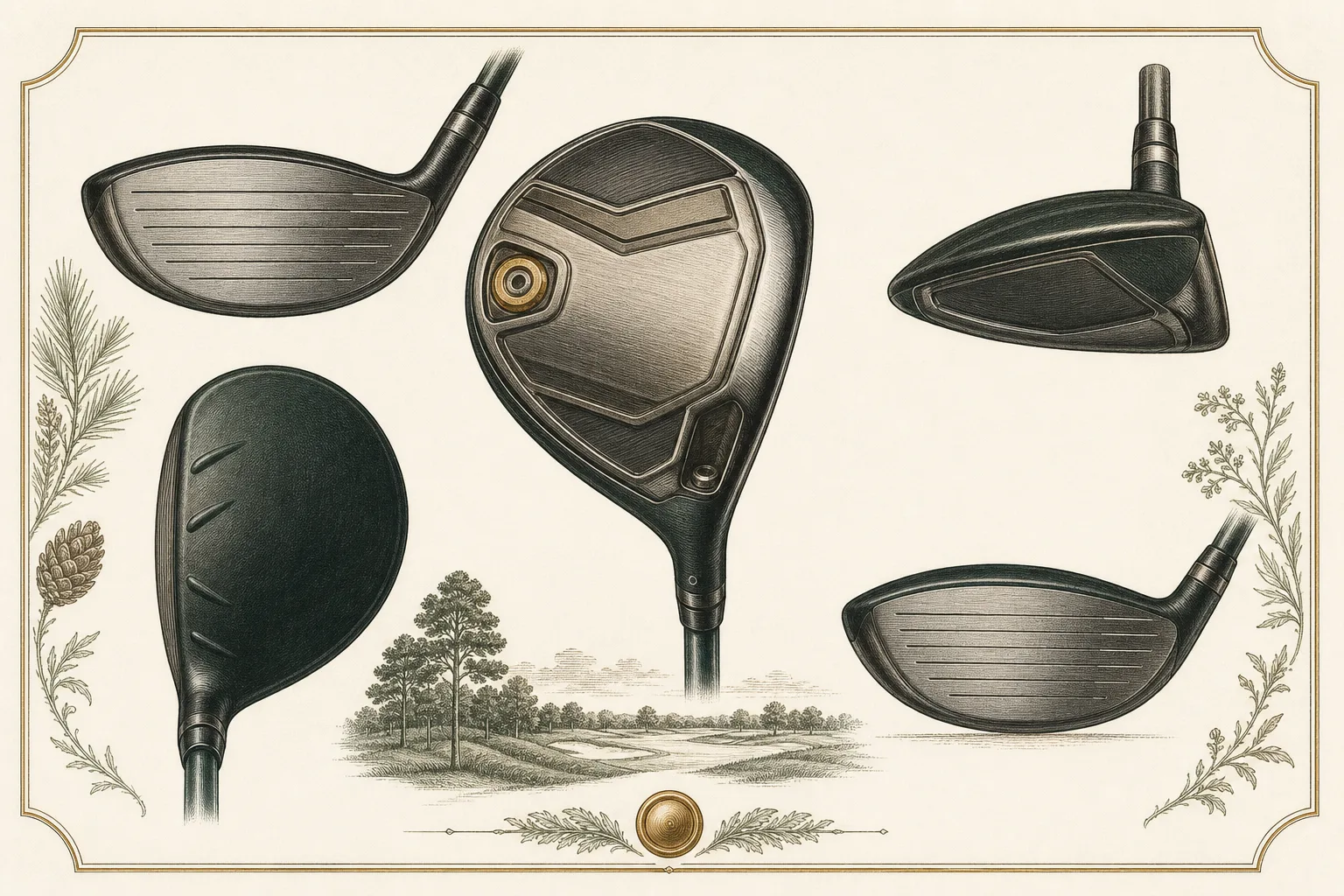
“A low-spin players' fairway wood (rung-3 posture) - strong, forward-CG performance for fast swings; slower swings give up launch and forgiveness.”
The odd one out in Ping's 2016 G fairway-wood family: instead of a normal 3-wood loft spread, the Stretch was built as a single-loft (13°), 184cc, tee-only 3-wood - 15cc larger than the standard G fairway with Ping's thinnest fairway-wood crown to date, letting the CG sit low and back for a low-spin, driver-like ball flight off a tee. Ping also moved the sole weight toward the center and roughly 16.5mm more forward than the standard G fairway to flatten trajectory further, aiming the club specifically at fast-swinging players who wanted more accuracy than a full driver without giving up much distance.
Not a cult classic, but a genuinely distinctive design choice worth flagging honestly: Ping built it as essentially a single-purpose, off-the-tee 3-wood rather than a do-everything fairway wood, a niche concept that drew dedicated coverage (National Club Golfer, Plugged In Golf) as an accuracy-focused alternative to a driver off the tee. That focused design intent, not scarcity or forum reverence, is what earns it 'notable' over plain commodity.
For faster swingers (driver swing speed 95+ mph) who want a more accurate, lower-flying alternative to a driver off the tee, not a traditional fairway-wood buyer looking to hit approach shots from the deck. Slower swingers give up both launch and forgiveness compared to a standard-loft G fairway wood and should look elsewhere.
Released inside Ping's broader 2016 G fairway family (standard G, SF Tec, Stretch) as a driver-accuracy alternative; the concept anticipates the 'mini-driver'/high-loft driver-substitute category that became more common across the industry in later years.
Built for low spin and penetrating flight, not maximum forgiveness - the forward-shifted CG and low-spin bias that make it accurate off a tee for a fast swinger also mean it rewards a centered, driver-like strike more than a game-improvement fairway wood does. A 6 reflects a players'-oriented low-spin build, clearly less forgiving than Ping's own G/G SF Tec fairway woods (8) despite sharing the same product family and year.
Calibrated across the whole catalog — a tour blade scores low here on purpose; it means control, not ease.
A niche, single-loft club with a smaller buyer pool than a standard fairway wood: private-party prices run roughly $50-$90 in 2026, similar to other superseded 2016 Ping woods, with no premium for its unusual concept.
Reading is one thing — hitting is another. Book a bay and see the numbers for yourself before you buy anywhere.