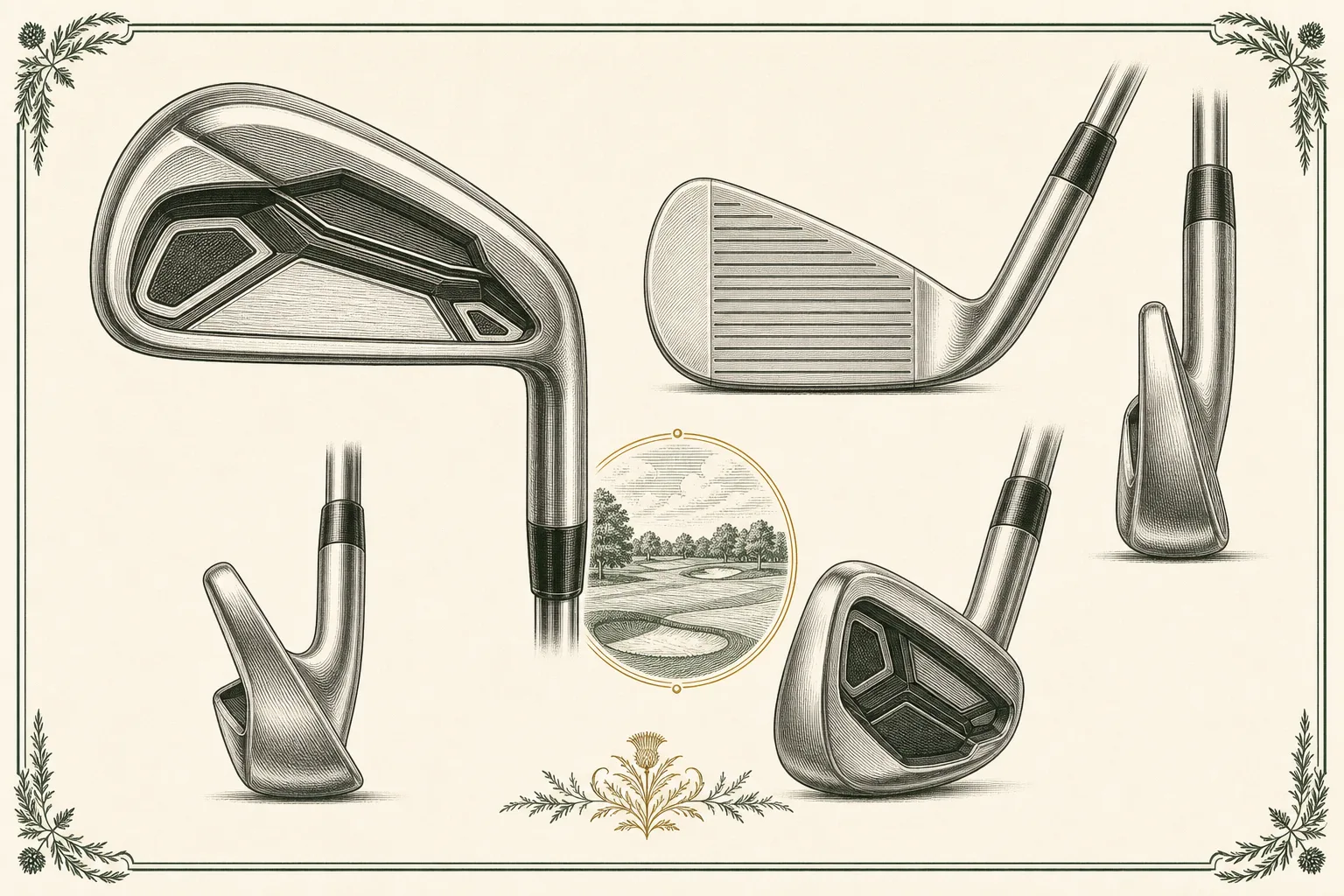
“Forged 1025 hollow body with a suspended tungsten core: the first forged Epic, a players-distance profile with a strong 27-degree 7-iron. Compact-ish look, soft feel, premium per-club price.”
The 2019 Epic Forged was Callaway's first forged iron to use a Suspended Tungsten Core — a tungsten weight held in place by urethane microspheres inside a forged 1025 carbon-steel hollow body — to precisely locate the center of gravity behind a Variable Face Thickness face. It is a players-distance iron dressed in premium materials: forged construction and tungsten weighting deliver a soft, crisp feel and forgiving mis-hits, but the lofts are jacked strong (the 7-iron sits around 27°) to chase distance-race numbers. Reviewers clocked it 10-15 yards longer on average than Callaway's own Apex 19 irons, while also questioning what justified a retail price north of $2,000 for the set.
No cult following developed and it was superseded within a year or two by later Apex/Paradym forged offerings, but it is a technically notable club: the Suspended Tungsten Core was a genuine engineering first for a Callaway forged iron, and its steep premium pricing became a recurring talking point in contemporaneous reviews rather than fading quietly.
Mid-handicap players (roughly 5-15) with enough speed (85-100mph iron swing) to control strong lofts, who want forged feel plus extra distance without a full players'-cavity workload. Not for golfers who need help stopping the ball on greens (the strong lofts fight that) or for anyone unwilling to pay a serious per-club premium for the tungsten/forged construction.
Launched in 2019 alongside the ultralight Epic Forged Star spinoff, sitting above Callaway's mainstream Rogue and Apex 19 irons in price and positioning. It was superseded by Callaway's subsequent Apex/Apex Pro and Paradym forged lines within a couple of years, part of the annual-refresh churn typical of premium iron platforms.
Genuinely forgiving for a forged players-distance iron — shots struck low on the face still get airborne easily, and heel/toe misses retain plenty of ball speed thanks to the hollow-body/tungsten construction. It is not a game-improvement iron, though: the profile is more compact than a true GI cavity, and the extreme lofts trade off spin and stopping power on approach shots, so it demands more precise strike than a wide-sole GI set.
Calibrated across the whole catalog — a tour blade scores low here on purpose; it means control, not ease.
Individual used irons list from roughly $154 on Golf Avenue against an average retail value near $200 each — graded/warrantied store pricing. A realistic private-party complete set (4-PW, steel shafts) sells for something closer to $500-800 on eBay/SidelineSwap, a steep drop from the >$2,000 original retail that reflects both age and the narrow buyer pool for a premium niche iron.
Reading is one thing — hitting is another. Book a bay and see the numbers for yourself before you buy anywhere.
“Forged 1025 hollow body with a suspended tungsten core: the first forged Epic, a players-distance profile with a strong 27-degree 7-iron. Compact-ish look, soft feel, premium per-club price.”
The 2019 Epic Forged was Callaway's first forged iron to use a Suspended Tungsten Core — a tungsten weight held in place by urethane microspheres inside a forged 1025 carbon-steel hollow body — to precisely locate the center of gravity behind a Variable Face Thickness face. It is a players-distance iron dressed in premium materials: forged construction and tungsten weighting deliver a soft, crisp feel and forgiving mis-hits, but the lofts are jacked strong (the 7-iron sits around 27°) to chase distance-race numbers. Reviewers clocked it 10-15 yards longer on average than Callaway's own Apex 19 irons, while also questioning what justified a retail price north of $2,000 for the set.
No cult following developed and it was superseded within a year or two by later Apex/Paradym forged offerings, but it is a technically notable club: the Suspended Tungsten Core was a genuine engineering first for a Callaway forged iron, and its steep premium pricing became a recurring talking point in contemporaneous reviews rather than fading quietly.
Mid-handicap players (roughly 5-15) with enough speed (85-100mph iron swing) to control strong lofts, who want forged feel plus extra distance without a full players'-cavity workload. Not for golfers who need help stopping the ball on greens (the strong lofts fight that) or for anyone unwilling to pay a serious per-club premium for the tungsten/forged construction.
Launched in 2019 alongside the ultralight Epic Forged Star spinoff, sitting above Callaway's mainstream Rogue and Apex 19 irons in price and positioning. It was superseded by Callaway's subsequent Apex/Apex Pro and Paradym forged lines within a couple of years, part of the annual-refresh churn typical of premium iron platforms.
Genuinely forgiving for a forged players-distance iron — shots struck low on the face still get airborne easily, and heel/toe misses retain plenty of ball speed thanks to the hollow-body/tungsten construction. It is not a game-improvement iron, though: the profile is more compact than a true GI cavity, and the extreme lofts trade off spin and stopping power on approach shots, so it demands more precise strike than a wide-sole GI set.
Calibrated across the whole catalog — a tour blade scores low here on purpose; it means control, not ease.
Individual used irons list from roughly $154 on Golf Avenue against an average retail value near $200 each — graded/warrantied store pricing. A realistic private-party complete set (4-PW, steel shafts) sells for something closer to $500-800 on eBay/SidelineSwap, a steep drop from the >$2,000 original retail that reflects both age and the narrow buyer pool for a premium niche iron.
Reading is one thing — hitting is another. Book a bay and see the numbers for yourself before you buy anywhere.