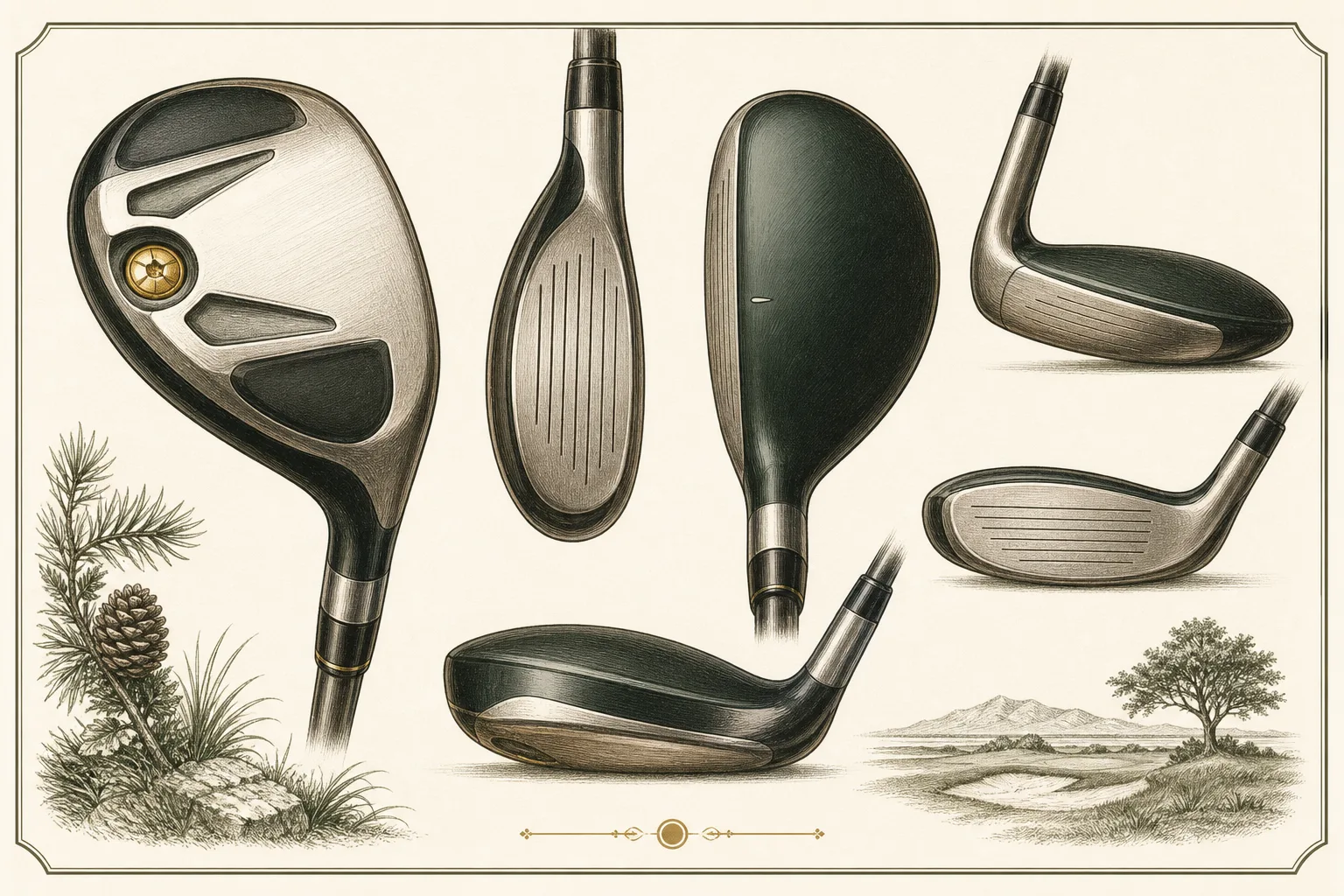
“One of the early great hybrids - Nickent's 3DX Ironwood was praised well beyond its price and helped legitimize the category. A genuinely forgiving rung-1 hybrid; a bargain-bin gem.”
The 3DX Ironwood turned Nickent — a small, single-backer clone company — into a legitimate tour presence almost overnight. Its '3DX' weighting placed tungsten low, deep, and toward the heel and toe simultaneously, a heel-toe-plus-back scheme unusual for a 2004 hybrid, giving it a penetrating flight that resisted the 'ballooning' typical of early hybrids. Nickent sold it across an enormous loft spread (roughly 14-29 degrees across variants) so it could fully replace long irons, and priced it meaningfully below Callaway/TaylorMade/Ping equivalents. Per the Darrell Survey, it was the #1 hybrid on the Nationwide Tour three years running and briefly #1 on the PGA Tour after the DC Ironwood variant launched in late 2005, with Jim Furyk among the tour players who gamed it.
Two independent trade sources (The Golf Wire's Darrell Survey recaps and GolfWRX's retrospective 'The story of Nickent Golf: From breakthroughs to bust') corroborate that the 3DX Ironwood was, for a stretch of 2005-2007, the single most-played hybrid family on both the Nationwide and PGA Tours — an extraordinary result for a small clone-turned-boutique brand competing against Callaway, Ping and TaylorMade. GolfWRX's history piece calls the Genex Ironwood 'one of the finest hybrids of all time.' Nickent's 2009 bankruptcy and the brand's subsequent dissolution as a house brand mean the 3DX is now remembered specifically as the high point of a company that couldn't sustain it — genuine nostalgia, not marketing myth.
Any handicap that struggles to launch long irons — the enormous loft range (roughly 14 to 29 degrees across the line) let it fill everything from a strong 2-iron slot down to a gap-wedge-adjacent role. Good players used it as a 2-3-iron replacement for penetrating trajectory into greens; higher handicaps used the higher-lofted versions as easy, high-launching long-game clubs. Not a fit for someone who wants a single modern hybrid with the latest low-spin, high-COR face technology — this is a 20-year-old design, however well-regarded.
Launched into the first real hybrid boom, competing directly with the TaylorMade Rescue Mid/TP and early Callaway/Ping hybrids, but undercutting all of them on price while matching their tour visibility — a rare combination for a non-major OEM. Nickent could not translate the hybrid win into its driver, iron, or putter lines, and when club sales collapsed industry-wide in 2008 the single-backer company had no cushion; it went into receivership in May 2009. A modern equivalent in spirit (not lineage) is any specialist iron-replacement hybrid like the Titleist U505 or Ping Crossover, built for exactly the same job the 3DX pioneered.
As an iron-replacement hybrid it is built to be forgiving: a wide, cambered sole and low-heel/low-toe tungsten weighting resist digging and stabilize off-center hits far better than the irons it was designed to replace. It does not reach max-GI hybrid territory (modern super-game-improvement hybrids sit a notch higher) but for a 2004-era iron-replacement club it was near the top of its class, which is consistent with the tour adoption by players who wanted a reliable long-iron substitute rather than raw distance.
Calibrated across the whole catalog — a tour blade scores low here on purpose; it means control, not ease.
Genuinely cheap today: eBay and 2nd Swing/Golf Avenue listings commonly show individual 3DX Ironwood hybrids at roughly $15-50 depending on loft, shaft and condition, reflecting both its age and Nickent's total exit from the market (no brand equity to prop up resale). It is a strong cost-per-performance buy for someone who wants a forgiving, easy-launching long-game club and doesn't care that the badge is defunct.
Reading is one thing — hitting is another. Book a bay and see the numbers for yourself before you buy anywhere.