“The iron that put Callaway on the map (short, straight, hollow hosel) and doubled their sales. Historically important but genuinely obsolete now with weak-by-modern-standards lofts and dated feel; a collector/nostalgia buy, not a gamer.”
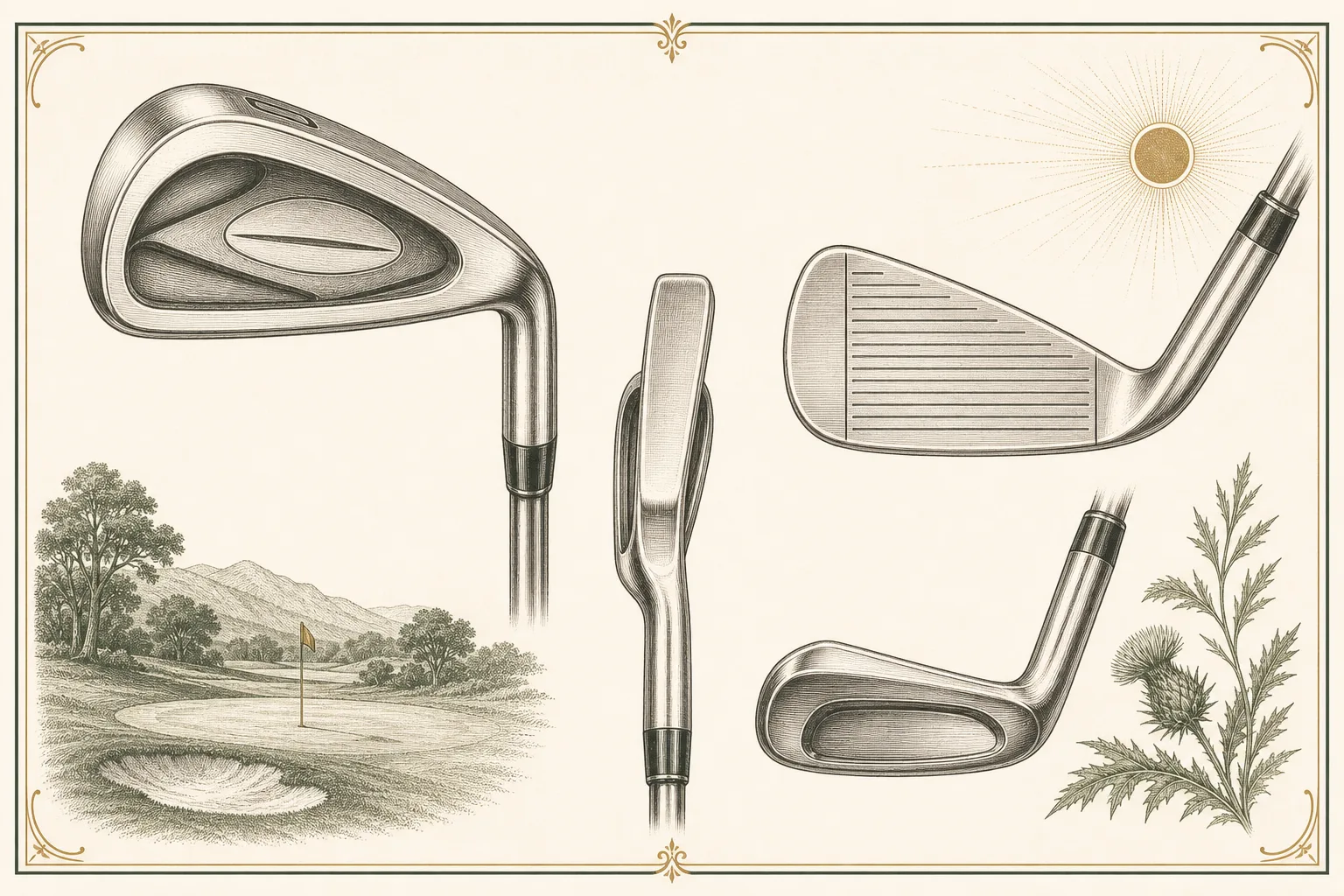
The S2H2 iron was the club that put Callaway Golf on the map: launched in 1988 alongside the S2H2 driver, it applied the same short-straight-hollow-hosel construction to a cavity-back iron, running the shaft through a shortened hosel down to the sole to shift weight off the neck and into the perimeter for a more stable, forgiving strike than the blades most golfers still gamed at the time. It arrived as Callaway was establishing itself as a dedicated club company, and the technology's reception helped more than double the company's sales in its first two years (from $4.8 million in 1988 to $10.4 million in 1989). By modern standards its cavity is shallow and its lofts are strong-for-1988-but-weak-by-today's-numbers (a 43-degree 9-iron, 48-degree PW), so it plays short and offers little of the perimeter weighting a 2020s GI iron delivers - it is historically foundational but not something a serious player would game today.
Historically significant as Callaway's first iron platform and a genuine sales catalyst that helped establish the company - documented across multiple Callaway-history retrospectives - but there's no active enthusiast hunt for clean sets, no tour-legend narrative, and no forum reverence comparable to a true cult classic. Its importance is as a corporate origin story, not a living collector or player fascination.
Essentially a collector/nostalgia piece today rather than a gamer's set - traditional, weak-by-modern-standards lofts and dated cavity geometry mean any current mid-or-high-handicap player will be better served by a modern GI iron. Its audience now is Callaway historians and vintage-equipment collectors assembling an early-Callaway set.
Launched into a late-1980s iron market still dominated by forged blades from Titleist, Hogan, and Mizuno, with Ping's Eye 2 (1982) as the reigning perimeter-weighted cavity pioneer. The S2H2 iron helped Callaway establish a foothold that led directly to the company becoming the number-one seller of irons and woods in the U.S. by 1995. It was succeeded through the Big Bertha iron line in the 1990s.
Genuinely more forgiving than the forged blades it displaced in 1988 - the bore-through hosel and perimeter weighting were real, novel advances for their moment - but it predates modern wide-sole, deep-undercut cavity engineering by more than a decade. Judged against today's full forgiveness spectrum it sits in the middle: better than a blade, well behind a modern max-GI iron with tungsten weighting and a hollow, face-cup construction.
Calibrated across the whole catalog — a tour blade scores low here on purpose; it means control, not ease.
Complete sets are inexpensive collector/curiosity items in 2026, typically $40-$100 depending on shaft and cosmetic condition; there's no meaningful premium beyond nostalgia since the geometry is obsolete for actual play and supply is not scarce.
Reading is one thing — hitting is another. Book a bay and see the numbers for yourself before you buy anywhere.
“The iron that put Callaway on the map (short, straight, hollow hosel) and doubled their sales. Historically important but genuinely obsolete now with weak-by-modern-standards lofts and dated feel; a collector/nostalgia buy, not a gamer.”
The S2H2 iron was the club that put Callaway Golf on the map: launched in 1988 alongside the S2H2 driver, it applied the same short-straight-hollow-hosel construction to a cavity-back iron, running the shaft through a shortened hosel down to the sole to shift weight off the neck and into the perimeter for a more stable, forgiving strike than the blades most golfers still gamed at the time. It arrived as Callaway was establishing itself as a dedicated club company, and the technology's reception helped more than double the company's sales in its first two years (from $4.8 million in 1988 to $10.4 million in 1989). By modern standards its cavity is shallow and its lofts are strong-for-1988-but-weak-by-today's-numbers (a 43-degree 9-iron, 48-degree PW), so it plays short and offers little of the perimeter weighting a 2020s GI iron delivers - it is historically foundational but not something a serious player would game today.
Historically significant as Callaway's first iron platform and a genuine sales catalyst that helped establish the company - documented across multiple Callaway-history retrospectives - but there's no active enthusiast hunt for clean sets, no tour-legend narrative, and no forum reverence comparable to a true cult classic. Its importance is as a corporate origin story, not a living collector or player fascination.
Essentially a collector/nostalgia piece today rather than a gamer's set - traditional, weak-by-modern-standards lofts and dated cavity geometry mean any current mid-or-high-handicap player will be better served by a modern GI iron. Its audience now is Callaway historians and vintage-equipment collectors assembling an early-Callaway set.
Launched into a late-1980s iron market still dominated by forged blades from Titleist, Hogan, and Mizuno, with Ping's Eye 2 (1982) as the reigning perimeter-weighted cavity pioneer. The S2H2 iron helped Callaway establish a foothold that led directly to the company becoming the number-one seller of irons and woods in the U.S. by 1995. It was succeeded through the Big Bertha iron line in the 1990s.
Genuinely more forgiving than the forged blades it displaced in 1988 - the bore-through hosel and perimeter weighting were real, novel advances for their moment - but it predates modern wide-sole, deep-undercut cavity engineering by more than a decade. Judged against today's full forgiveness spectrum it sits in the middle: better than a blade, well behind a modern max-GI iron with tungsten weighting and a hollow, face-cup construction.
Calibrated across the whole catalog — a tour blade scores low here on purpose; it means control, not ease.
Complete sets are inexpensive collector/curiosity items in 2026, typically $40-$100 depending on shaft and cosmetic condition; there's no meaningful premium beyond nostalgia since the geometry is obsolete for actual play and supply is not scarce.
Reading is one thing — hitting is another. Book a bay and see the numbers for yourself before you buy anywhere.