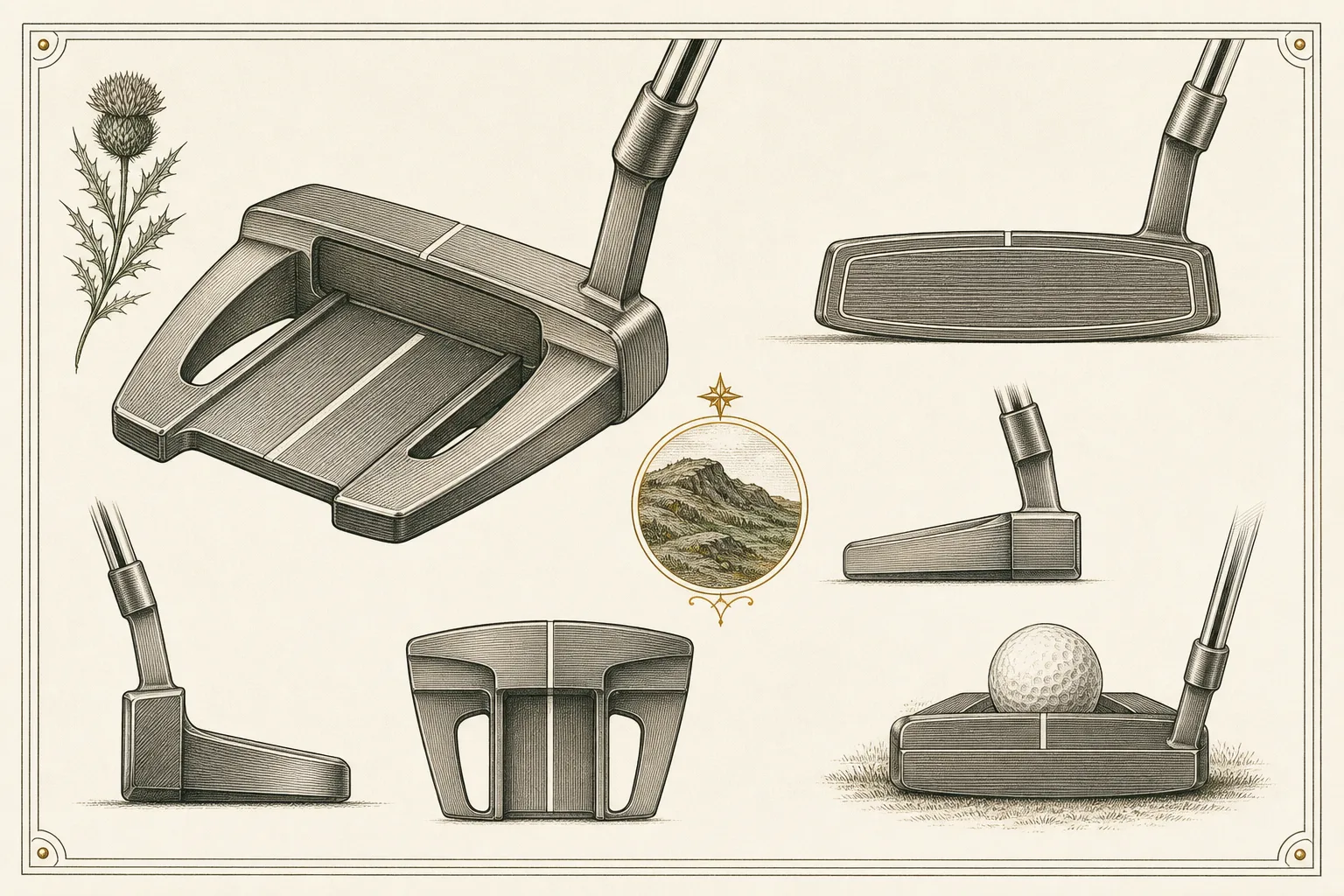
“The original Evnroll blade from the 2016 launch, a classic thin plumber-neck Anser shape. Sweet Face milling means off-center hits roll the same distance as pured ones, so it flatters a slight-arc stroke.”
The ER1 is the putter that launched Evnroll in 2016 and made Guerin Rife's name a third time — after his original Rife Putters and his two-bar/RollGroove face work, Rife founded Evnroll to build the roll-consistency idea to its conclusion. It is a classic thin plumber-neck Anser-style blade CNC-milled from a single billet of 303 stainless steel, hand-ground and finished to a 'tour level' standard. The whole point is the face: Evnroll's patented Sweet Face milling cuts a variable-depth groove pattern that imparts progressively more energy on off-center strikes, so a heel or toe hit rolls the same distance as a center strike and the pattern nudges the ball back toward the target line. Independent testing (Golfalot) measured dramatically tighter distance dispersion across the face than rival putters — the marketing claim of 'sweetest face in golf' is one of the rare ones backed by third-party data.
Evnroll burst onto the scene in 2016 and immediately won 'Sweetest Face in Golf' / best-blade recognition (Golfalot's face-consistency testing, later MyGolfSpy blade-putter honors), built on designer Guerin Rife's face-groove pedigree. The ER1 is the founding model and Rife's third act after Rife Putters and the Two Bar groove work — it carries genuine designer-driven cult standing among putter enthusiasts and fitters, sustained across a decade, rather than mass-market fame.
For a player with a slight-arc stroke who wants a traditional compact blade look but keeps leaving mis-hit putts the wrong distance — the Sweet Face directly targets that error. Feel-oriented players who like a firm, milled 303 stainless response and a plumber-neck Anser shape will feel at home. Who should skip it: players wanting maximum head MOI/alignment help (go to an Evnroll mallet or a fang), and bargain shoppers, since it is a premium-priced blade.
Debuted in 2016 into a blade market ruled by Scotty Cameron Newport, Odyssey and Ping Anser derivatives; Evnroll's differentiator was the face technology rather than the shape. The ER1 anchored a line that grew to mallets (ER5/ER8/ER11) and later 'v' and Neo Classics refreshes. Its lineage runs straight from Rife's earlier groove-face putters, and the Sweet Face idea influenced the broader industry conversation about face-milling for roll consistency.
Scored on a putter basis, and this is the interesting case: the ER1 is a small heel-toe-weighted blade, so on raw head MOI it forgives directional twist only modestly — a blade, not a mallet. But its forgiveness is a different axis: the Sweet Face milling makes off-center hits roll a consistent DISTANCE, which is where most three-putts come from (leaving it short/long, not offline). Golfalot's testing showed the face pattern held distance far tighter than a normal milled/insert face. So it earns a 6 rather than a blade's typical 4-5 — genuine, measured mis-hit help on speed, even though line stability is still blade-level. Cult status did not inflate this; the third-party data did.
Calibrated across the whole catalog — a tour blade scores low here on purpose; it means control, not ease.
Original MSRP was around $329-379. As a 2016 blade with steady enthusiast demand, it depreciates but holds better than commodity putters: realistic 2026 private-party value is roughly $90-190 depending on condition, finish and headcover (SidelineSwap showed a used ER1 near $100; retail-refurb sits higher). 2nd Swing reconditioned-retail listings run above private-sale — treat those as store prices. Clean examples with cover and original weights sit at the top of the band.
Reading is one thing — hitting is another. Book a bay and see the numbers for yourself before you buy anywhere.
“The original Evnroll blade from the 2016 launch, a classic thin plumber-neck Anser shape. Sweet Face milling means off-center hits roll the same distance as pured ones, so it flatters a slight-arc stroke.”
The ER1 is the putter that launched Evnroll in 2016 and made Guerin Rife's name a third time — after his original Rife Putters and his two-bar/RollGroove face work, Rife founded Evnroll to build the roll-consistency idea to its conclusion. It is a classic thin plumber-neck Anser-style blade CNC-milled from a single billet of 303 stainless steel, hand-ground and finished to a 'tour level' standard. The whole point is the face: Evnroll's patented Sweet Face milling cuts a variable-depth groove pattern that imparts progressively more energy on off-center strikes, so a heel or toe hit rolls the same distance as a center strike and the pattern nudges the ball back toward the target line. Independent testing (Golfalot) measured dramatically tighter distance dispersion across the face than rival putters — the marketing claim of 'sweetest face in golf' is one of the rare ones backed by third-party data.
Evnroll burst onto the scene in 2016 and immediately won 'Sweetest Face in Golf' / best-blade recognition (Golfalot's face-consistency testing, later MyGolfSpy blade-putter honors), built on designer Guerin Rife's face-groove pedigree. The ER1 is the founding model and Rife's third act after Rife Putters and the Two Bar groove work — it carries genuine designer-driven cult standing among putter enthusiasts and fitters, sustained across a decade, rather than mass-market fame.
For a player with a slight-arc stroke who wants a traditional compact blade look but keeps leaving mis-hit putts the wrong distance — the Sweet Face directly targets that error. Feel-oriented players who like a firm, milled 303 stainless response and a plumber-neck Anser shape will feel at home. Who should skip it: players wanting maximum head MOI/alignment help (go to an Evnroll mallet or a fang), and bargain shoppers, since it is a premium-priced blade.
Debuted in 2016 into a blade market ruled by Scotty Cameron Newport, Odyssey and Ping Anser derivatives; Evnroll's differentiator was the face technology rather than the shape. The ER1 anchored a line that grew to mallets (ER5/ER8/ER11) and later 'v' and Neo Classics refreshes. Its lineage runs straight from Rife's earlier groove-face putters, and the Sweet Face idea influenced the broader industry conversation about face-milling for roll consistency.
Scored on a putter basis, and this is the interesting case: the ER1 is a small heel-toe-weighted blade, so on raw head MOI it forgives directional twist only modestly — a blade, not a mallet. But its forgiveness is a different axis: the Sweet Face milling makes off-center hits roll a consistent DISTANCE, which is where most three-putts come from (leaving it short/long, not offline). Golfalot's testing showed the face pattern held distance far tighter than a normal milled/insert face. So it earns a 6 rather than a blade's typical 4-5 — genuine, measured mis-hit help on speed, even though line stability is still blade-level. Cult status did not inflate this; the third-party data did.
Calibrated across the whole catalog — a tour blade scores low here on purpose; it means control, not ease.
Original MSRP was around $329-379. As a 2016 blade with steady enthusiast demand, it depreciates but holds better than commodity putters: realistic 2026 private-party value is roughly $90-190 depending on condition, finish and headcover (SidelineSwap showed a used ER1 near $100; retail-refurb sits higher). 2nd Swing reconditioned-retail listings run above private-sale — treat those as store prices. Clean examples with cover and original weights sit at the top of the band.
Reading is one thing — hitting is another. Book a bay and see the numbers for yourself before you buy anywhere.