“Ultralight, high-launch women's hybrid - rung-1 forgiveness for slower speeds; the light shaft is the fit, not a downgrade.”
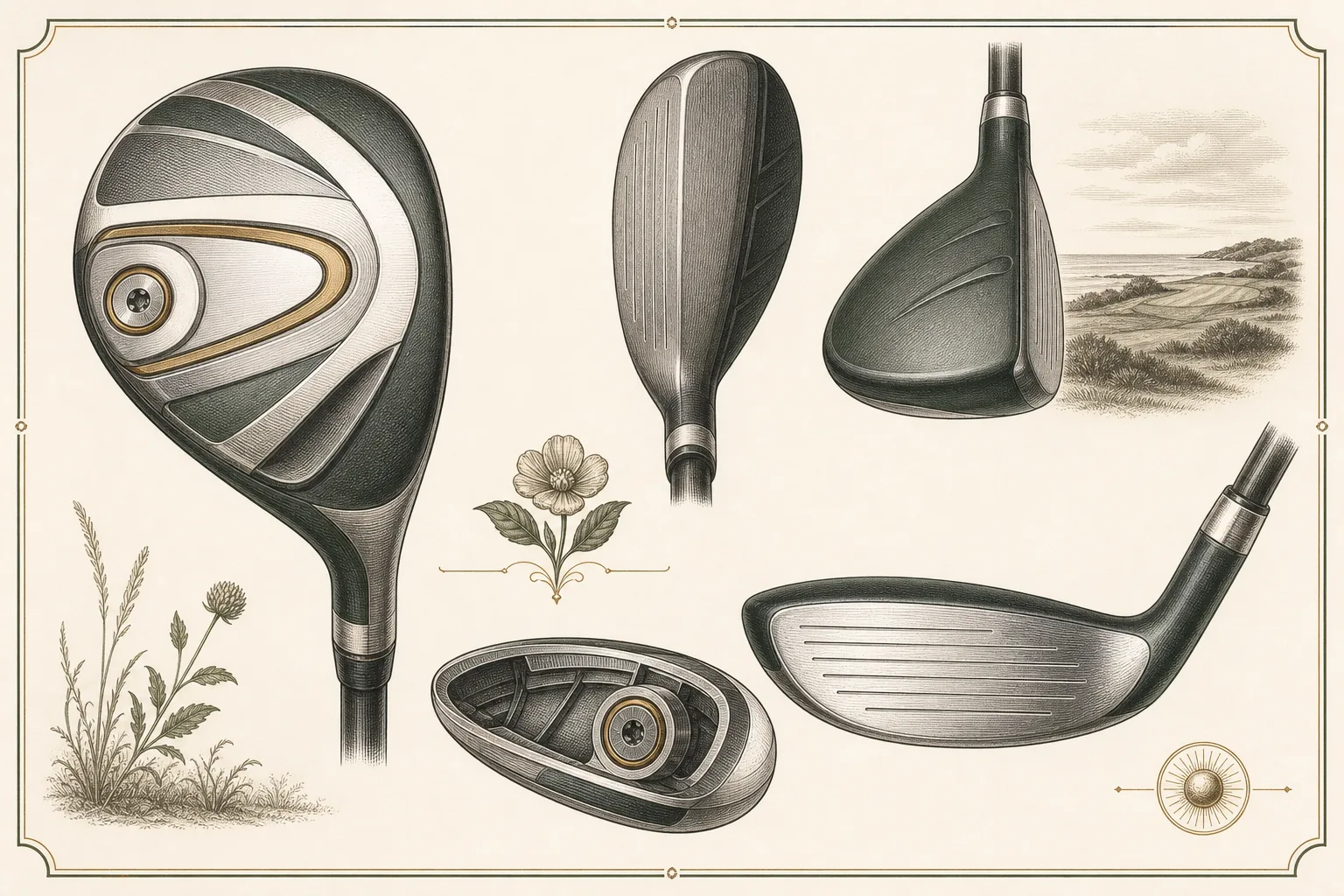
The G Le Hybrid rounded out Ping's 2017 women's platform with a thin Carpenter 455 steel face, a low and deep center of gravity for elevated launch, and Ping's Trajectory Tuning 2.0 adjustable hosel for trajectory customization - a genuine adjustability feature carried down from Ping's mainstream hybrid lines rather than trimmed out for the women's version. It came in three lofts (22, 26 and 30 degrees) on the lightweight ULT 230 Lite shaft. A reader review published by Women & Golf described the 4-hybrid (22 degrees) in a navy-and-mint color scheme with a matching headcover, noting it felt lighter and more flexible through impact than a comparable rescue club from another manufacturer, though squaring the face took some adjustment.
It drew genuinely positive independent reader feedback at launch but built no following of its own - a well-executed, functional forgiveness club within a two-year product cycle, replaced by the G Le2 Hybrid with no lasting reputation beyond that original review coverage.
Women golfers with slower swing speeds needing forgiving distance from a long-iron replacement, who also want the option to have loft and lie adjusted by a fitter rather than buying a single fixed configuration.
Part of the 2017 G Le family built on Ping's flagship-derived technology, sitting between the 2015 Rhapsody hybrid and the 2019 G Le2 hybrid in Ping's roughly two-year women's product refresh cycle.
A low, deep CG and high-MOI construction were paired with a thin, fast-flexing face for distance retention on off-center hits, while the retained Trajectory Tuning 2.0 hosel let a fitter dial in launch and spin rather than accept one fixed setup - unusual flexibility for an entry-tier women's hybrid.
Calibrated across the whole catalog — a tour blade scores low here on purpose; it means control, not ease.
Used units commonly sell for roughly $37-$110 depending on condition, ordinary pricing for a well-regarded but unremarkable mid-2010s women's hybrid with no scarcity premium.
Reading is one thing — hitting is another. Book a bay and see the numbers for yourself before you buy anywhere.
“Ultralight, high-launch women's hybrid - rung-1 forgiveness for slower speeds; the light shaft is the fit, not a downgrade.”
The G Le Hybrid rounded out Ping's 2017 women's platform with a thin Carpenter 455 steel face, a low and deep center of gravity for elevated launch, and Ping's Trajectory Tuning 2.0 adjustable hosel for trajectory customization - a genuine adjustability feature carried down from Ping's mainstream hybrid lines rather than trimmed out for the women's version. It came in three lofts (22, 26 and 30 degrees) on the lightweight ULT 230 Lite shaft. A reader review published by Women & Golf described the 4-hybrid (22 degrees) in a navy-and-mint color scheme with a matching headcover, noting it felt lighter and more flexible through impact than a comparable rescue club from another manufacturer, though squaring the face took some adjustment.
It drew genuinely positive independent reader feedback at launch but built no following of its own - a well-executed, functional forgiveness club within a two-year product cycle, replaced by the G Le2 Hybrid with no lasting reputation beyond that original review coverage.
Women golfers with slower swing speeds needing forgiving distance from a long-iron replacement, who also want the option to have loft and lie adjusted by a fitter rather than buying a single fixed configuration.
Part of the 2017 G Le family built on Ping's flagship-derived technology, sitting between the 2015 Rhapsody hybrid and the 2019 G Le2 hybrid in Ping's roughly two-year women's product refresh cycle.
A low, deep CG and high-MOI construction were paired with a thin, fast-flexing face for distance retention on off-center hits, while the retained Trajectory Tuning 2.0 hosel let a fitter dial in launch and spin rather than accept one fixed setup - unusual flexibility for an entry-tier women's hybrid.
Calibrated across the whole catalog — a tour blade scores low here on purpose; it means control, not ease.
Used units commonly sell for roughly $37-$110 depending on condition, ordinary pricing for a well-regarded but unremarkable mid-2010s women's hybrid with no scarcity premium.
Reading is one thing — hitting is another. Book a bay and see the numbers for yourself before you buy anywhere.