“Forged players' distance iron with a Flash Face Cup in the long irons and Callaway's Tungsten Energy Core for the first time in an Apex iron; confirmed loft set (3i=19, 7i=30.5, PW=43) shared with the Apex 19 (Golf Club Guru / Today's Golfer). A rung-3 set and a common long-term home; strong used value.”
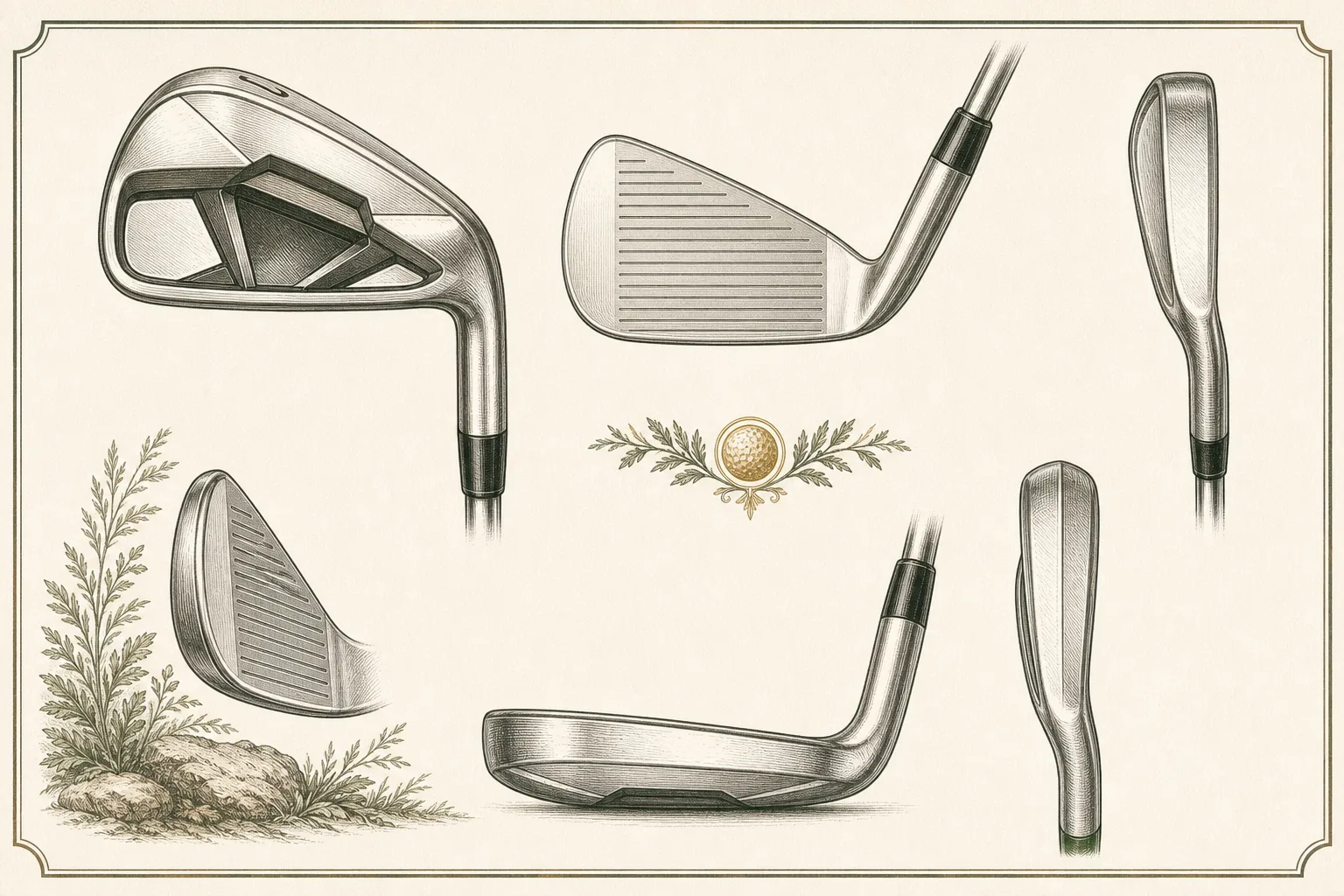
The Apex 21 continued Callaway's long-running Apex line — the lineage that effectively created the modern 'players-distance' iron category — with a forged, hollow-body construction packing up to 90 grams of tungsten low in the head for a deep, stable CG, five times the tungsten mass of the prior Apex generation. It was the first forged Apex to carry Callaway's A.I.-designed Flash Face Cup, giving each loft its own face architecture tuned by machine learning for ball speed and spin, and it used vibration-damping urethane microspheres inside the hollow 1025 carbon-steel body to chase a one-piece forged feel. It shipped with the True Temper Elevate 95 low-kick shaft, sitting between the more forgiving Apex DCB 21 (0.5° weaker lofts) and the more compact Apex Pro 21 (2–2.5° stronger).
Not a standalone cult object — it is one generation in an Apex lineage whose reputation was built over 20+ years — but genuinely well-regarded on its own merits: reviewers (Plugged In Golf, Today's Golfer, Golfstead) consistently rank it at or near the top of the players-distance category for its generation, specifically for consistency of ball speed and spin across the face rather than raw one-shot distance numbers.
Stronger players who still want some forgiveness, or aspiring players who want a smaller, more compact iron head than a full game-improvement design — Callaway itself frames this as the set's sweet spot. Reviewers cautioned that its relatively low spin can make it harder to hold firm greens, so a player who relies on spin to stop approach shots should get properly shaft-fit or consider the higher-lofted, higher-spin alternatives in Callaway's own range.
Released in 2021 as part of Callaway's three-way Apex 21 family (Apex 21, Apex Pro 21, Apex DCB 21), competing directly against TaylorMade's P790/P770, Titleist's T200/T100, and Mizuno's JPX921 Forged/Hot Metal Pro in the crowded players-distance category that Apex itself pioneered decades earlier. It succeeded the Apex 19 and was followed by the Apex 24/Apex Pro generations.
Forgiving for its compact size thanks to the tungsten-loaded hollow-body construction and AI-tuned face, but reviewers were explicit that feel firms up substantially and impact gets noticeably louder away from center — it is calibrated forgiveness for a better player who wants a smaller, players-shaped head, not the forgiveness of a true game-improvement iron. Its own family member, the Apex DCB 21, is built to be more forgiving still at the cost of a chunkier look.
Calibrated across the whole catalog — a tour blade scores low here on purpose; it means control, not ease.
A mainstream premium forged iron from a major brand; realistic 2026 private-party pricing for a clean 4-PW or 5-PW set (roughly 5 years old) runs about $550–$750 depending on shaft upgrade and condition, holding value better than a typical game-improvement iron of the same age because forged players-distance sets from major brands depreciate more slowly and retain steady demand among better players.
Reading is one thing — hitting is another. Book a bay and see the numbers for yourself before you buy anywhere.
“Forged players' distance iron with a Flash Face Cup in the long irons and Callaway's Tungsten Energy Core for the first time in an Apex iron; confirmed loft set (3i=19, 7i=30.5, PW=43) shared with the Apex 19 (Golf Club Guru / Today's Golfer). A rung-3 set and a common long-term home; strong used value.”
The Apex 21 continued Callaway's long-running Apex line — the lineage that effectively created the modern 'players-distance' iron category — with a forged, hollow-body construction packing up to 90 grams of tungsten low in the head for a deep, stable CG, five times the tungsten mass of the prior Apex generation. It was the first forged Apex to carry Callaway's A.I.-designed Flash Face Cup, giving each loft its own face architecture tuned by machine learning for ball speed and spin, and it used vibration-damping urethane microspheres inside the hollow 1025 carbon-steel body to chase a one-piece forged feel. It shipped with the True Temper Elevate 95 low-kick shaft, sitting between the more forgiving Apex DCB 21 (0.5° weaker lofts) and the more compact Apex Pro 21 (2–2.5° stronger).
Not a standalone cult object — it is one generation in an Apex lineage whose reputation was built over 20+ years — but genuinely well-regarded on its own merits: reviewers (Plugged In Golf, Today's Golfer, Golfstead) consistently rank it at or near the top of the players-distance category for its generation, specifically for consistency of ball speed and spin across the face rather than raw one-shot distance numbers.
Stronger players who still want some forgiveness, or aspiring players who want a smaller, more compact iron head than a full game-improvement design — Callaway itself frames this as the set's sweet spot. Reviewers cautioned that its relatively low spin can make it harder to hold firm greens, so a player who relies on spin to stop approach shots should get properly shaft-fit or consider the higher-lofted, higher-spin alternatives in Callaway's own range.
Released in 2021 as part of Callaway's three-way Apex 21 family (Apex 21, Apex Pro 21, Apex DCB 21), competing directly against TaylorMade's P790/P770, Titleist's T200/T100, and Mizuno's JPX921 Forged/Hot Metal Pro in the crowded players-distance category that Apex itself pioneered decades earlier. It succeeded the Apex 19 and was followed by the Apex 24/Apex Pro generations.
Forgiving for its compact size thanks to the tungsten-loaded hollow-body construction and AI-tuned face, but reviewers were explicit that feel firms up substantially and impact gets noticeably louder away from center — it is calibrated forgiveness for a better player who wants a smaller, players-shaped head, not the forgiveness of a true game-improvement iron. Its own family member, the Apex DCB 21, is built to be more forgiving still at the cost of a chunkier look.
Calibrated across the whole catalog — a tour blade scores low here on purpose; it means control, not ease.
A mainstream premium forged iron from a major brand; realistic 2026 private-party pricing for a clean 4-PW or 5-PW set (roughly 5 years old) runs about $550–$750 depending on shaft upgrade and condition, holding value better than a typical game-improvement iron of the same age because forged players-distance sets from major brands depreciate more slowly and retain steady demand among better players.
Reading is one thing — hitting is another. Book a bay and see the numbers for yourself before you buy anywhere.