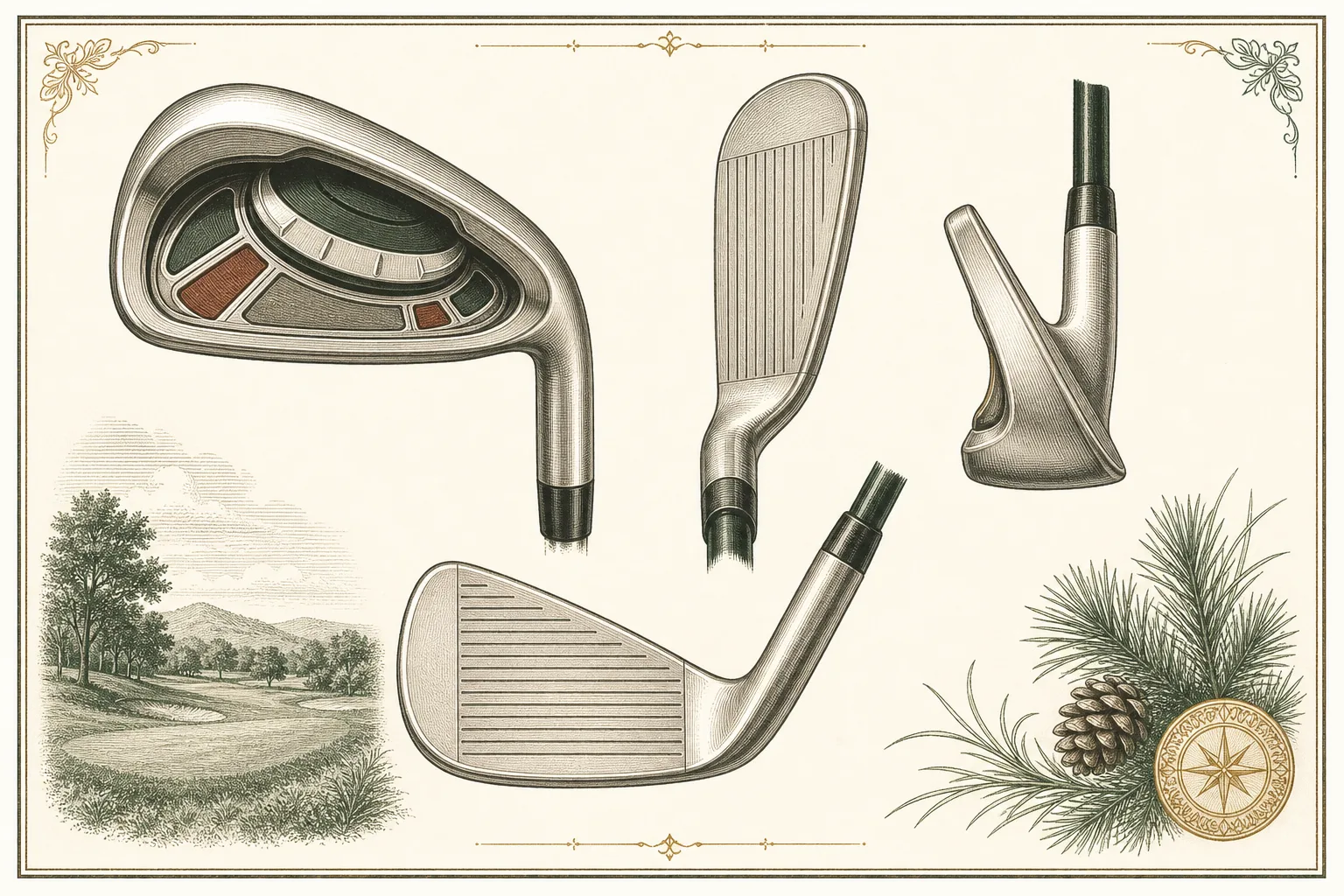
“Rung-1 game-improvement iron with strong forgiveness and the same 23-to-45-degree loft set Ping kept through G20 and G25. A common used-market first set; nothing wrong with living here for years.”
The G15 irons (2009) refined the Custom Tuning Port Ping introduced on the G10 - engineers reshaped it to shed about seven grams, then redirected that weight to the perimeter and toe for a meaningful MOI jump. Cast from 17-4 stainless with a wide sole and low, rearward CG, it launched high and forgave off-center strikes as well as any Ping iron to that point, while also meeting the incoming 2010 USGA groove-conformity rules years ahead of the amateur deadline. It kept the same broad 23-to-45-degree loft spread the G-series had used since the G2/G5 era, so the improvements were entirely about tightening tolerances and forgiveness rather than chasing distance. It became one of the most commonly recommended budget game-improvement sets on the used market for years afterward.
Not a cult item, but it earned durable, specific praise beyond generic marketing copy - reviewers repeatedly singled it out at launch as 'one of the most forgiving irons Ping has made,' and used-club buying guides still cite it a decade-plus later as a strong low-cost forgiving set, a longer shelf life of recommendation than most single-generation G-series entries.
Higher-handicap and slower-swing-speed players (sub-92 mph per Ping's own fitting data) who want forgiveness and easy launch over shot-shaping - a legitimate long-term 'first real set' many players never feel the need to upgrade from. Better ball-strikers wanting workability or a compact look should look at Ping's players-cavity offerings of the same era instead.
Released in 2009 as the direct successor to the G10 iron set and immediate predecessor to the G20 (2011), which kept nearly the identical loft set through three generations. It competed against Callaway's Big Bertha Diablo and TaylorMade's Burner irons of the same period, all chasing the same slower-swing-speed, forgiveness-first buyer.
The reshaped Custom Tuning Port moved real mass to the toe and perimeter versus the G10, producing a genuine, measured MOI increase - a wide-sole, deep-cavity design built explicitly to minimize distance loss on mis-hits. It is not a top-of-class max-GI iron (no hollow-body or multi-material construction), but within cast-cavity technology of its generation it sits near the top.
Calibrated across the whole catalog — a tour blade scores low here on purpose; it means control, not ease.
Complete used G15 sets commonly sell for $150-300 in 2026 depending on shaft, condition and whether they carry Ping's original steel (AWT) or graphite shafts - a fraction of the original $753 MSRP, typical depreciation for a 15-plus-year-old game-improvement iron with no collector premium.
Reading is one thing — hitting is another. Book a bay and see the numbers for yourself before you buy anywhere.