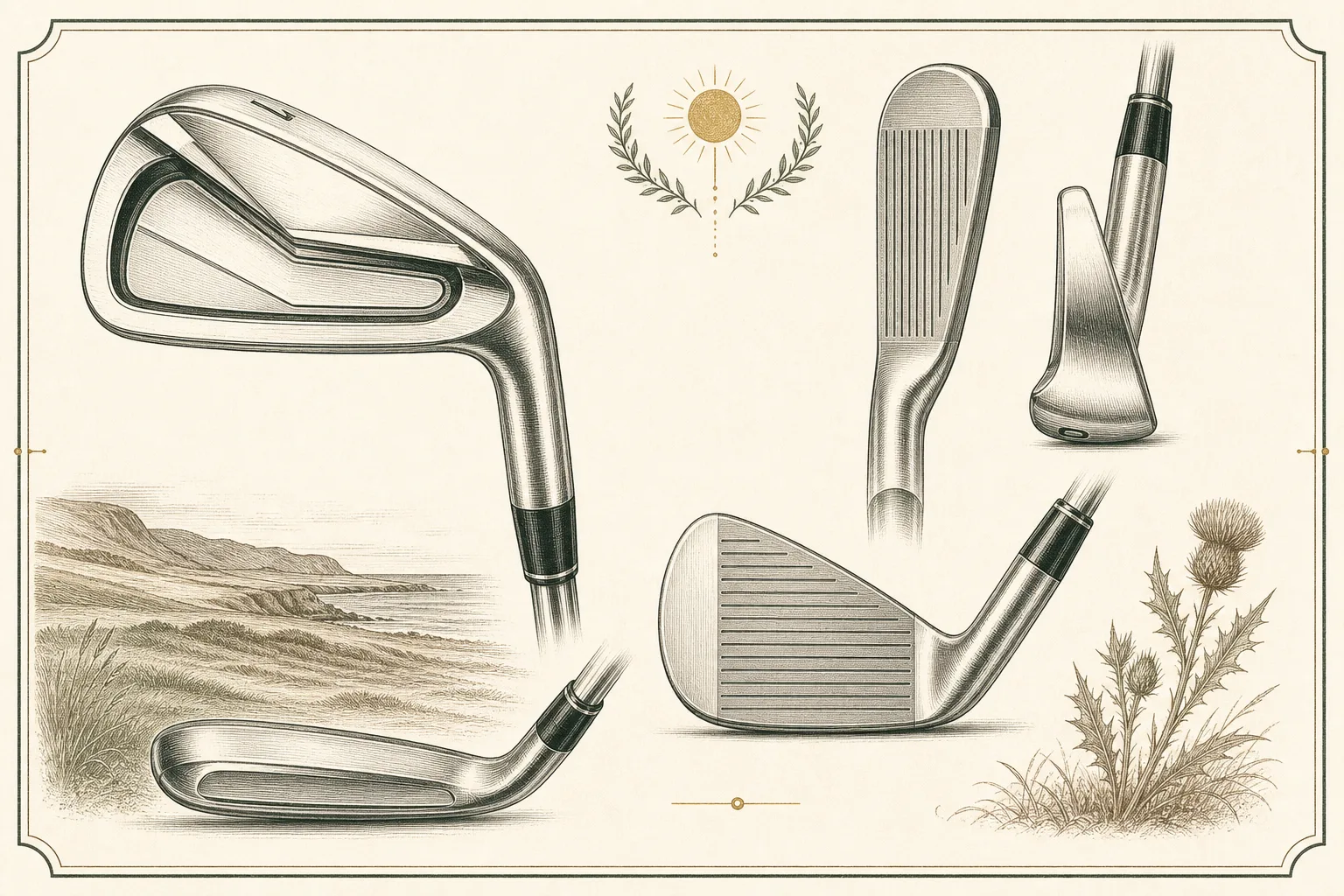
“The Z945 is a true muscleback blade forged from 1020 carbon steel. Maximum workability and feedback, zero forgiveness - reserve it for consistent ball-strikers.”
Srixon's 2014 flagship tour blade, the top rung of the Z-family (Z945/Z745/Z545) developed with input from staff pros Hideki Matsuyama and Graeme McDowell. Forged from soft 1020 carbon steel into a compact, thin-topline muscleback shape, it added tungsten weighting to the 3-6 irons to correct CG in the longer clubs and a new Tour V.T. Sole - more leading bounce, less trailing bounce - to cut turf drag and tighten dispersion. Multiple independent reviewers called it among the best-looking blade sets on the market at launch. It was replaced two years later by the Z965.
Repeatedly singled out in reviews for its looks and tour development pedigree (Matsuyama, McDowell), and gamed by Srixon staffers McDowell and Shane Lowry, but there is no documented forum-driven hunt or scarcity premium - it reads as a well-regarded, ordinary tour blade generation rather than a cult classic.
Single-digit handicappers and better ball-strikers who want classic shape, workability, and soft forged feel. Mid-to-high handicappers chasing forgiveness or easy height should look at a cavity-back or GI iron instead - this will punish inconsistent contact.
Sat above the Z745 cavity-back and Z545 game-improvement iron in Srixon's tiered 2014 Z-family lineup, competing with Titleist 714 MB, Mizuno MP-64, and TaylorMade Tour Preferred MB. Its Tour V.T. Sole geometry carried forward into the 2016 Z965 that replaced it.
Tungsten weighting in the long irons and the Tour V.T. Sole nudge stability, but this is a true compact muscleback blade with a thin sole and small sweet spot; off-center strikes cost real distance and feel. A 3 here means 'about as forgiving as a blade of this era gets,' not forgiving in absolute terms.
Calibrated across the whole catalog — a tour blade scores low here on purpose; it means control, not ease.
Realistic 2026 private-party value for a clean steel 4-PW set runs roughly $150-$300; individual irons commonly sell in the $15-$30 range on 2nd Swing/eBay. GolfBidder's cached average trade-in figure (quoted around EUR341) reflects an earlier, higher point in its depreciation curve and should not be read as current 2026 pricing for a 12-year-old blade.
Reading is one thing — hitting is another. Book a bay and see the numbers for yourself before you buy anywhere.