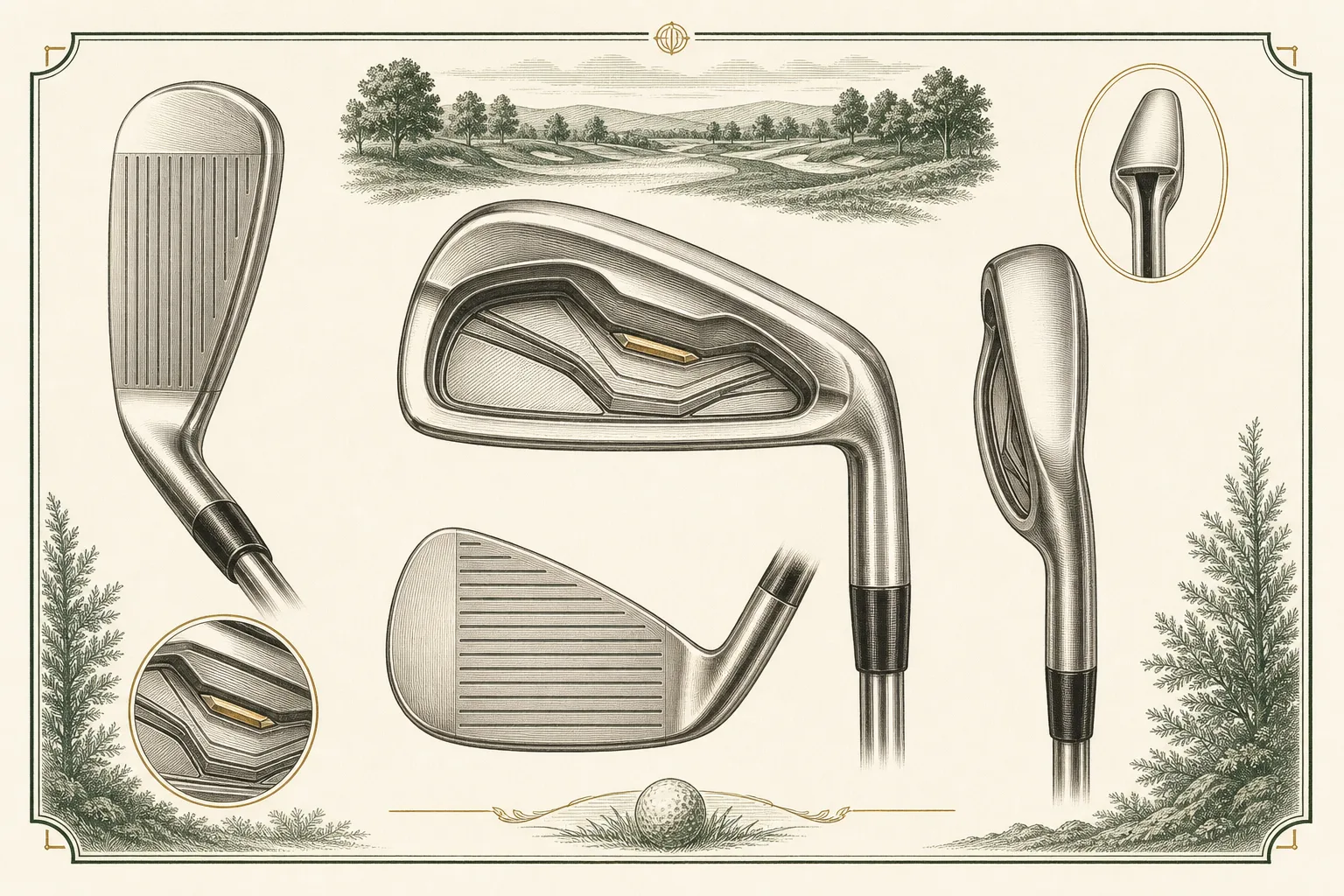
“Forged version of the Y-Tune deep-cavity concept, released alongside the cast MX-100 for early-2009 launch, stated for low-to-high handicap. Softer feel than the cast MX-100 but still a forgiveness-first rung-1 club.”
Released alongside the cast MX-100 in Mizuno's early-2009 game-improvement launch, the MX-200 applied Mizuno's one-piece Grain Flow Forging process to a genuine game-improvement shape - something rare in the category. The Y-Tune reinforced face pad on the back extended the sweet spot roughly 5% toward the toe, the most common miss location, while a triple-cut sole reduced drag through the turf for cleaner contact. Multiple period test panels rated it best-on-test among forged game-improvement irons that year, with reviewers noting the trajectory stayed penetrating rather than ballooning despite the cavity pocket, and calling the combination of soft forged feel and real forgiveness 'something special' that 'does not come around very often.'
This is the sleeper pattern in miniature: independent reviewers at Today's Golfer, Golf Monthly, and other test panels rated it best-on-test among forged game-improvement irons for its year, genuinely glowing praise for a GI iron. Yet by 2026 there is no ongoing forum reverence, scarcity, or resale premium attached to it - it faded from memory the way most GI irons do despite having earned unusually strong contemporary acclaim, which is exactly what separates a sleeper from a lasting cult classic.
Mid-handicap golfers who want real forgiveness without giving up forged feel entirely. A very-high handicapper is better served by the cast MX-100 sibling's larger margin for error; a low-handicap player wanting true workability should look to Mizuno's MP line instead.
Launched as the forged counterpart to the cast MX-100 in Mizuno's 2009 game-improvement push, competing with TaylorMade's Burner 2.0, Callaway's X-20/X-22, and Ping's G10. Its Y-Tune sole geometry was carried forward into the MX-300 successor released the following year.
Forgiving for a forged iron - the Y-Tune face pad measurably extends the sweet spot toward the toe and the triple-cut sole helps contact - but it sits below a true cast super-game-improvement iron like its MX-100 sibling in absolute forgiveness. It splits the difference: more forgiving than a players' cavity, less than a purpose-built cast SGI set.
Calibrated across the whole catalog — a tour blade scores low here on purpose; it means control, not ease.
Complete sets commonly sell for roughly $90-180 private-party in 2026 - forged construction holds value somewhat better than the cast MX-100/MX-19 siblings, but there is no collector premium.
Reading is one thing — hitting is another. Book a bay and see the numbers for yourself before you buy anywhere.