“SS/WS/TS/ES grind matrix and sharper precision-milled grooves (~350rpm more spin than original Glide); AWT 2.0 introduced here as a stock option. Steel-dominant players' wedge; a durable identity club.”
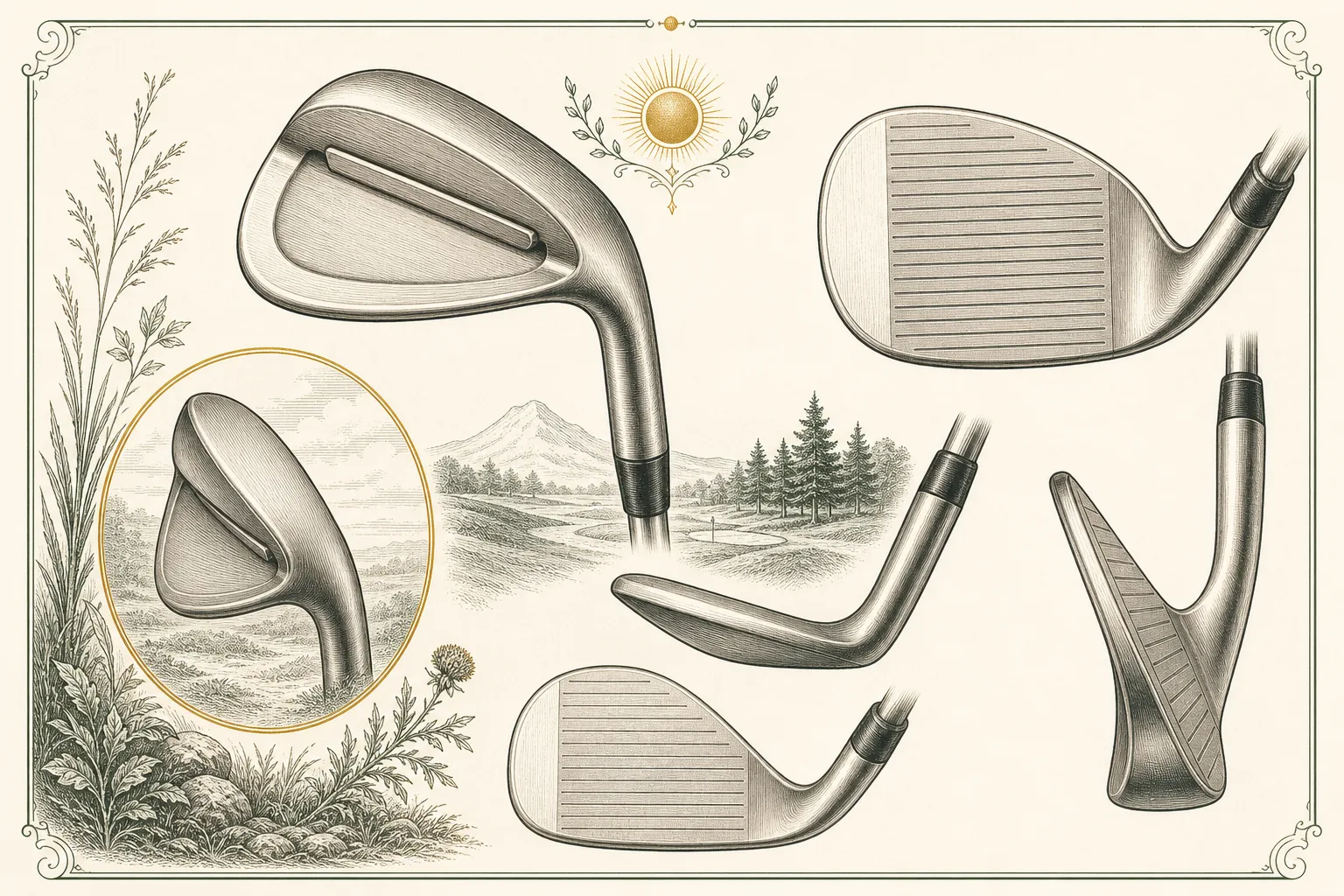
Glide 2.0 (2017) was Ping's mainstream players-wedge refresh -- a workmanlike upgrade of the 2015 original rather than a reinvention. Ping steepened the groove side-walls by 4 degrees using precision milling (16 to 20 degrees on the 46-52 lofts, 24 to 28 on the 54-60s) and added an extra groove or two per face, which Ping's own testing pegged at 1,000-1,500 rpm more spin on 40-70 yard shots and 500+ rpm on full swings versus the first Glide. Heads are 431 stainless steel in a moisture-shedding Hydropearl chrome finish that cuts sole friction through wet turf. The line kept its four sole grinds (SS/WS/ES/TS) so a fitter can match sole to attack angle, and it carries the longer, less-tapered Dyla-Wedge grip and a stock AWT 2.0 wedge shaft. Competent, well-fit, and thoroughly un-flashy.
No cult, and that's the honest verdict: Glide 2.0 is a high-volume, mass-fit players wedge with no lawsuit, no legend, no scarcity, and no forum reverence -- just solid reviews and a big installed base. Ping refreshed it on schedule to 3.0 and then 4.0. Its value is functional: a dependable, gettable wedge, not a collectible. Grading it 'commodity' is a positive, evidence-backed finding, not a knock.
For the mid handicap up through better players who want a properly fit sole grind and reliable greenside spin without paying for a boutique wedge -- especially anyone who benefits from the WS/ES wider soles in soft turf or sand. Less ideal for the elite ball-striker on firm, fast turf who wants a thinner, more manipulable tour grind (the TS helps, but s159/Glide 4.0 T or a tour wedge suit that player better).
The middle child of Ping's Glide family -- successor to the 2015 Glide, superseded by Glide 3.0 (2019) and Glide 4.0 (2022). It competed against Cleveland's CBX/RTX, Titleist Vokey SM6/SM7, and Callaway Mack Daddy wedges of the era. The ES grind carries forward Ping's Eye2 sole DNA; the modern equivalent in Ping's own line is Glide 4.0 or the tour-focused s159.
Moderate for a wedge. The 431-stainless head, cavity-style back weighting and -- crucially -- the fitted sole-grind system let a player pick a wider, higher-bounce sole (WS or the Eye2-derived ES) that forgives steep, fat and sand strikes, or a tighter one (TS) for shallow sweepers. Matched correctly it turns turf interaction into a strength for a mid-handicap. It's still a players' wedge, not a super-game-improvement chipper, so mishit distance control on thin strikes suffers. A 6 sits it above a compact tour blade wedge and below a dedicated cavity chipper.
Calibrated across the whole catalog — a tour blade scores low here on purpose; it means control, not ease.
Realistic 2026 private-party value runs roughly $40-85 per wedge depending on loft, grind popularity and groove wear -- it's plentiful and depreciates like the volume product it is. Popular 54/56/58/60 lofts in clean condition sit at the top of that band; worn grooves (the whole point of a wedge) and beat soles drop it lower. Reconditioned-retail listings run higher but overstate private-party reality. It does not appreciate.
Reading is one thing — hitting is another. Book a bay and see the numbers for yourself before you buy anywhere.
“SS/WS/TS/ES grind matrix and sharper precision-milled grooves (~350rpm more spin than original Glide); AWT 2.0 introduced here as a stock option. Steel-dominant players' wedge; a durable identity club.”
Glide 2.0 (2017) was Ping's mainstream players-wedge refresh -- a workmanlike upgrade of the 2015 original rather than a reinvention. Ping steepened the groove side-walls by 4 degrees using precision milling (16 to 20 degrees on the 46-52 lofts, 24 to 28 on the 54-60s) and added an extra groove or two per face, which Ping's own testing pegged at 1,000-1,500 rpm more spin on 40-70 yard shots and 500+ rpm on full swings versus the first Glide. Heads are 431 stainless steel in a moisture-shedding Hydropearl chrome finish that cuts sole friction through wet turf. The line kept its four sole grinds (SS/WS/ES/TS) so a fitter can match sole to attack angle, and it carries the longer, less-tapered Dyla-Wedge grip and a stock AWT 2.0 wedge shaft. Competent, well-fit, and thoroughly un-flashy.
No cult, and that's the honest verdict: Glide 2.0 is a high-volume, mass-fit players wedge with no lawsuit, no legend, no scarcity, and no forum reverence -- just solid reviews and a big installed base. Ping refreshed it on schedule to 3.0 and then 4.0. Its value is functional: a dependable, gettable wedge, not a collectible. Grading it 'commodity' is a positive, evidence-backed finding, not a knock.
For the mid handicap up through better players who want a properly fit sole grind and reliable greenside spin without paying for a boutique wedge -- especially anyone who benefits from the WS/ES wider soles in soft turf or sand. Less ideal for the elite ball-striker on firm, fast turf who wants a thinner, more manipulable tour grind (the TS helps, but s159/Glide 4.0 T or a tour wedge suit that player better).
The middle child of Ping's Glide family -- successor to the 2015 Glide, superseded by Glide 3.0 (2019) and Glide 4.0 (2022). It competed against Cleveland's CBX/RTX, Titleist Vokey SM6/SM7, and Callaway Mack Daddy wedges of the era. The ES grind carries forward Ping's Eye2 sole DNA; the modern equivalent in Ping's own line is Glide 4.0 or the tour-focused s159.
Moderate for a wedge. The 431-stainless head, cavity-style back weighting and -- crucially -- the fitted sole-grind system let a player pick a wider, higher-bounce sole (WS or the Eye2-derived ES) that forgives steep, fat and sand strikes, or a tighter one (TS) for shallow sweepers. Matched correctly it turns turf interaction into a strength for a mid-handicap. It's still a players' wedge, not a super-game-improvement chipper, so mishit distance control on thin strikes suffers. A 6 sits it above a compact tour blade wedge and below a dedicated cavity chipper.
Calibrated across the whole catalog — a tour blade scores low here on purpose; it means control, not ease.
Realistic 2026 private-party value runs roughly $40-85 per wedge depending on loft, grind popularity and groove wear -- it's plentiful and depreciates like the volume product it is. Popular 54/56/58/60 lofts in clean condition sit at the top of that band; worn grooves (the whole point of a wedge) and beat soles drop it lower. Reconditioned-retail listings run higher but overstate private-party reality. It does not appreciate.
Reading is one thing — hitting is another. Book a bay and see the numbers for yourself before you buy anywhere.